
Prem Chand is one of the many rickshaw drivers who spend their days darting and weaving along Delhi’s hectic roads. And like an increasing number of the city’s many thousands of rickshaws, Chand’s vehicle is electric.
He used to drive a gas-powered cab but ditched it eight months ago when he did the math and realized an e-rickshaw was far cheaper to run. Plus there’s an added bonus: it pumps no tailpipe pollution into the city’s famously toxic air.
“This is good for my pocket and for my environment, so why wouldn’t I make the switch?” Chand said.
Electric three-wheeler vehicles dominate in many Indian cities, relied on for short journeys between metro stations, offices, shops and homes. It’s not just an urban phenomenon, either; e-rickshaws have proliferated in rural areas. Across India, nearly 60% of all three-wheeler sales are now electric.

The transport revolution unfolding in the world’s most populous country is messy — plenty of e-rickshaws are unauthorized and run on stolen electricity — but its speed and scale is reflective of a remarkable clean energy boom.
While many look to China as an unassailable clean energy superpower, India’s electrification pathway may end up being even faster, according to a new report from climate think tank Ember, with big implications for the rest of the world. India is the planet’s third-biggest climate polluter and what happens here affects everyone.
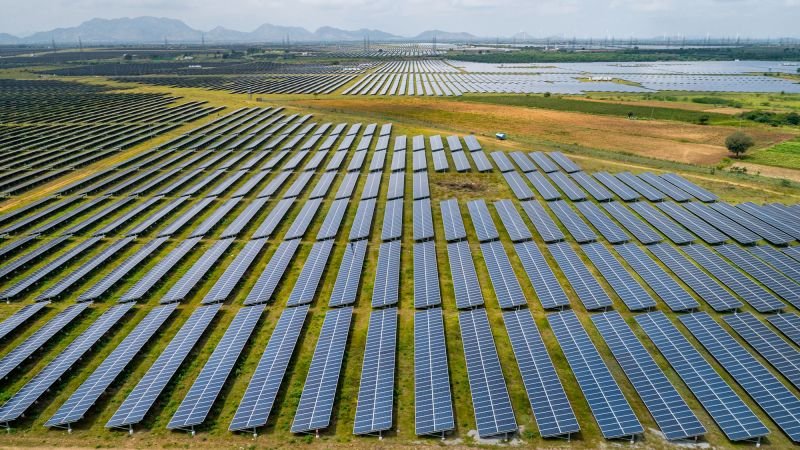
To compare the energy pathways of the two countries, Ember looked at what was happening in China in 2012, when it had similar income levels to India today, around $11,000 per person. China had virtually no solar capacity at that point, but solar currently makes up 9% of India’s electricity mix, from rooftop installations to huge sprawling solar farms. India is now the world’s third-largest solar power producer.
It’s a similar story for electric vehicles. EVs account for around 5% of all car sales in India and it sells more electric three-wheelers than any other country. In 2012, China had very few EVs on its roads.
That’s not to say India isn’t still heavily reliant on planet-heating fossil fuels. It has plans to scale up coal over the next two decades and its oil consumption is growing.
The country’s soaring energy demand means, even though it’s adding renewable energy at pace, coal is not yet getting displaced from the grid, said Debajit Palit from the Centre for Climate Change & Energy Transition at the Chintan Research Foundation, an independent think tank.
Yet, even as India remains wedded to the dirtiest fossil fuel, its coal consumption is roughly 40% of China’s at the same stage of development, Ember found. India also has much lower oil demand for transport, about half China’s levels per person in 2012.
China may now be on course to become the world’s first electrostate, but it built its might on fossil fuels, said Kingsmill Bond, energy strategist for Ember and a report author. It opted for the cheapest, most accessible energy, he said, “which 30 years ago, was fossil technology, but now it’s not; it’s electrotech.”
In contrast, India could “leapfrog” an era of more intensive fossil fuel burning and take a shortcut to a cleaner energy future, Bond said.
India’s clean energy transition is being driven mainly by one thing: cost.
In 2004, when China used a similar amount of energy per person as India does now, coal was about ten times cheaper than solar. Today, solar energy plus the cost to store it is about half as much as new coal plants, according to Ember.
Costs of solar panels, wind turbines and batteries have all plummeted. Battery prices alone dropped 40% in 2024, Bond said. These kinds of steep reductions simply aren’t possible with fossil fuels, he added.

Clean energy can also help give India something many countries are seeking: energy independence.
For the Trump administration this phrase is shorthand for boosting oil and gas, reviving coal and strangling wind and solar. For India, clean energy offers the chance to reduce its reliance on other countries in an increasingly volatile world.
India imports close to 90% of its oil and half its gas, leaving it exposed to price shocks and geopolitical turmoil, said Thijs Van de Graaf, an associate professor of international politics at Ghent University. “Renewables help reduce this vulnerability,” he said.
There are challenges. India’s clean energy rollout still relies on China, which dominates supply chains for critical minerals and electrotech.
India does have plans to reduce its dependence. Over the last decade, solar module production has surged 12-fold, Ember’s report noted. The government has also launched a “national critical mineral mission” to up production, Palit said.
This offers a big potential advantage. The US is becoming an increasingly unreliable trade partner, and China’s supply-chain monopolies are striking fear into many countries. There’s a growing demand for alternative trading partners, Ember’s report noted. A huge trade deal signed between India and the European Union last month has been interpreted as a sign of this shift.
Exactly how quickly — and how messily — India’s clean energy revolution might play out isn’t yet clear. But the overall takeaway is that India is charting a faster path to clean energy than that taken by China, Bond said: It’s generating more solar, burning far less fossil fuel and electrifying transportation at a quicker rate.
What India is doing could also be mirrored in other emerging economies, which may be able to harness increasingly cheap wind and solar at an even faster rate to power their economic development, Bond said.
The kicker is President Donald Trump — who outspokenly detests clean energy and promotes fossil fuels — may be helping drive this revolution. His transactional, “go-it-alone” approach only pushes energy import-dependent countries toward clean energy, Van de Graaf said. “The result is a growing divergence: a US prioritizing fossil fuel dominance, and emerging economies positioning themselves for an electrified energy future.”
CNN’s Esha Mitra in New Delhi contributed to this report.