
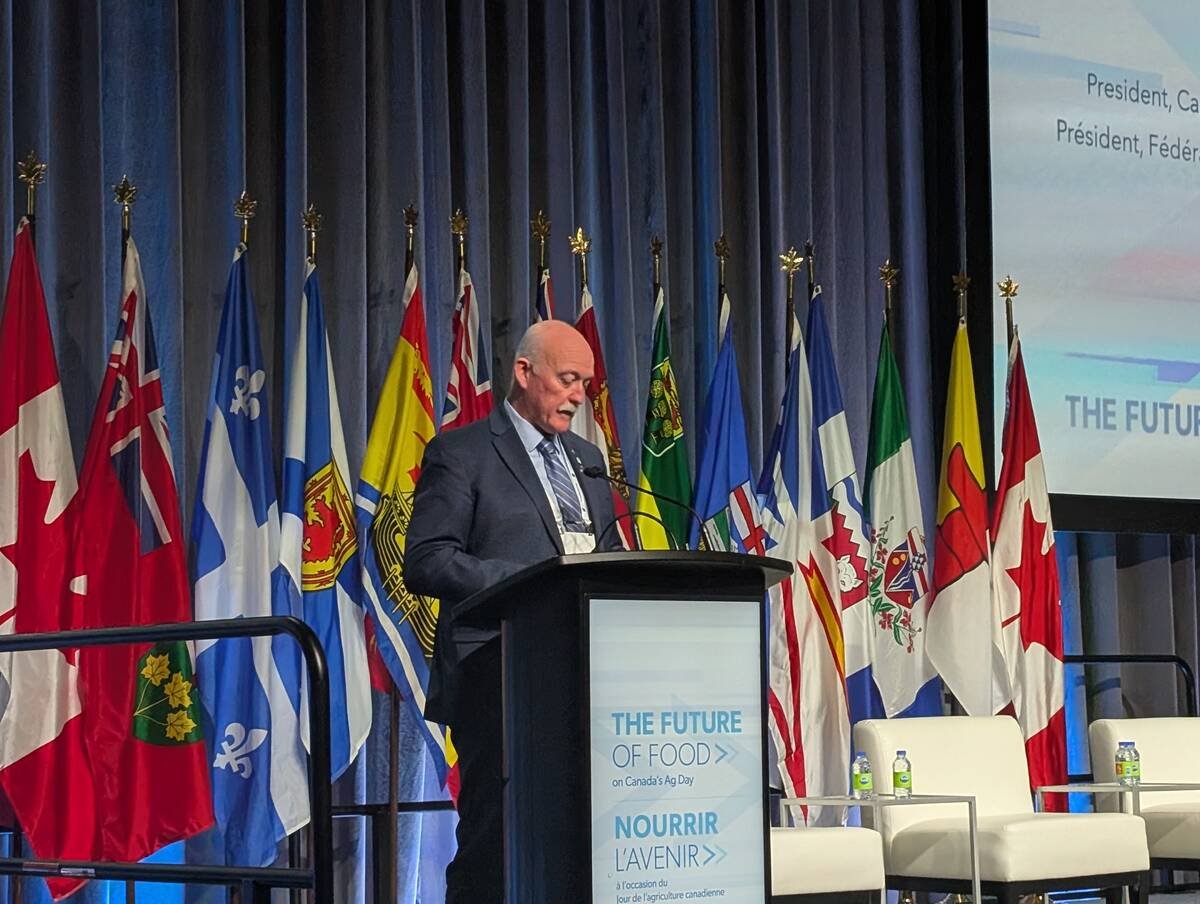
Glacier FarmMedia — A forcefully worded letter from Canadian agricultural groups to the federal government urges that the Canada-United States-Mexico Agreement (CUSMA) remains unchanged.
Why it matters: Free trade is critical for Canadian farmers, as much of what they produce is exported.
“We feel the current agreement is a good one and we’d like to see it continue as is,” said Keith Currie, Canadian Federation of Agriculture president, adding the request includes signing it for the original 16-year completion date without weakening its provisions or introducing any changes that negatively affect the agricultural sector.
Read Also

U.S. livestock: Cattle mostly lower Monday
Cattle futures on the Chicago Mercantile Exchange were mostly lower Monday, seeing a modest correction to start the week after…
“It’s really important to make the job of governments harder to ignore us when we are together as an industry.”
Signed by 98 Canadian food and agricultural value chain organizations, the letter mirrors one signed and submitted to Congress by 124 United States food and agricultural value chain organizations in October for the 2026 Joint Review of CUSMA public consultation, placing pressure on both governments to respect the agriculture industry’s support for the agreement.
Highlighting CUSMA’s instrumental role in building a stable, integrated and thriving North American agricultural market, the letter highlighted specific areas Canadian farmers, ranchers and processors would like to remain untouched.
“We are calling on governments to maintain the agreement’s SPS (sanitary and phytosanitary) provisions, which have improved transparency and ensured science-based treatment of agricultural products—protecting plant and animal health,” the letter states. “The continuation of science-based regulatory cooperation is critical to ensuring timely access to agricultural innovations.”
It also reflects full support for the Chapter 31 dispute settlement provisions designed to resolve “barriers that otherwise disrupt market stability and growth.”
Political and geopolitical events of the last decade are shifting the narrative, making it necessary for Canada’s 260-plus commodities, along with Mexico and the U.S. agricultural sectors, to support one another, Currie explained.
The letter said that between 2005 and 2023, CUSMA tripled the value of North American agriculture and agrifood trade to the tune of approximately C$400 billion (US$285 billion).
Currie said the three countries are aligned through a shared language, goals and collaborative relationship-building to strengthen and improve the sector.
“We all need each other’s help, and we can’t get this across the finish line unless we’re all pushing in the same direction,” he explained, adding all three countries are aligned through a shared language, goals, and collaborative relationship-building to strengthen and improve the sector.
“When the deal is all done, I would certainly be happy with an advantage for our farmers, but I don’t want to see it come at the detriment of either my colleagues, my farmer friends in the U.S., or relationships between nations.”
Currie said consumers now have a better understanding of agriculture and the agri-food industry’s role in driving Canada’s economy forward, gaining a clearer perspective on what food security means to them.
A recent Nanos poll asking Canadians to rank the government’s top two priorities for countering U.S. tariffs found that agriculture ranked first with 29 per cent, and 19 per cent ranked it as a secondary priority.
Automotive was second, with primary and secondary priority ratings of 24 and 18 per cent, respectively.
Provincially, Prairie provinces showed 42 per cent agricultural support. In comparison, automotive garnered 18 per cent, while others saw agriculture gain 26 to 28 per cent as the primary priority and automotive from 14 to 24 per cent.
Ontario was an outlier, ranking automotive as the primary with 35 per cent and agriculture at 24 per cent. Softwood lumber was the top concern in British Columbia, with 35 per cent, and second in Atlantic Canada at 24 per cent.
“(Consumers) want to make sure the government understands that they recognize agriculture is important,” explained Currie. “That helps us now go to the government and say, ‘Look, this is in the national interest. Food security is important. Economic security is also important, and agriculture wants to be part of the team.”
