
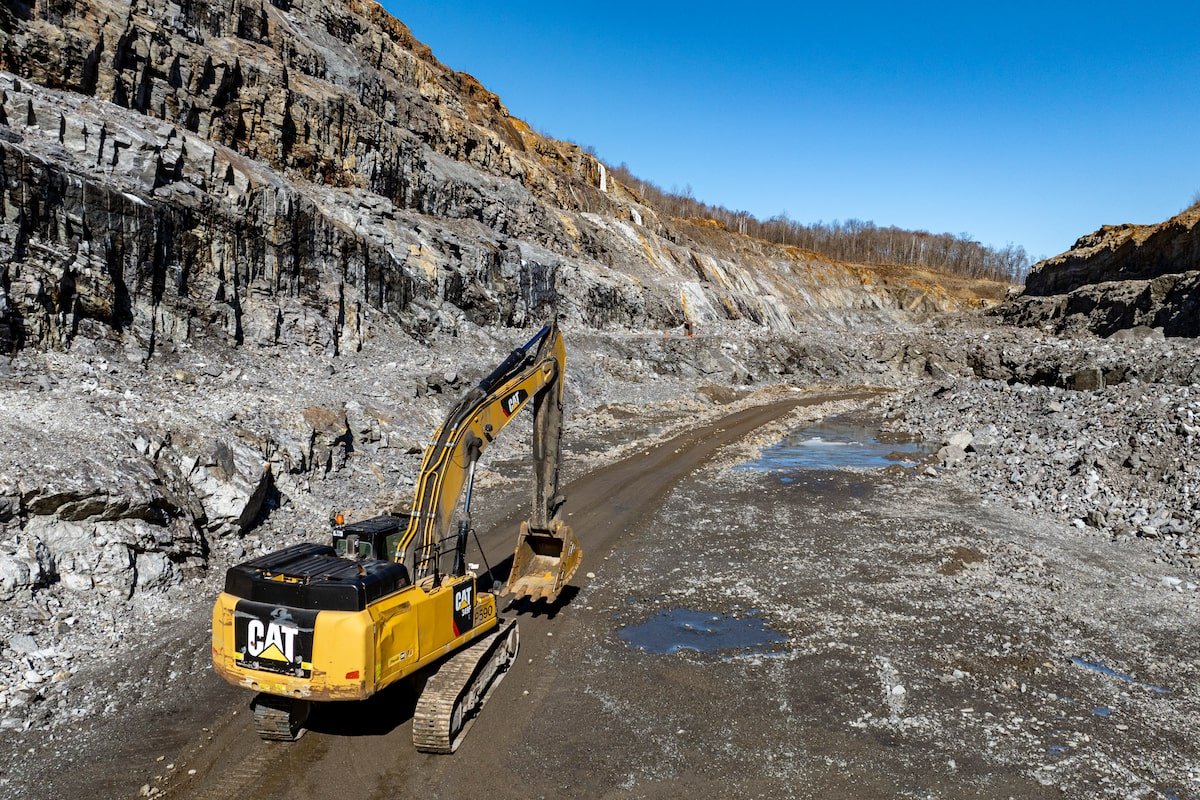
The TSX and TSX Venture Exchange list more than 1,000 mining companies, making Canada a major player.SEBASTIEN ST-JEAN/Getty Images
George Anderson is a former deputy minister at Natural Resources Canada.
China’s recent suspension of exports of rare earth minerals and rare earth magnets was shocking. The vulnerability of key industries and even for certain military supplies, which depend on those commodities, has been laid bare.
China’s action brought the U.S. to the table, where it leveraged important concessions from the Trump administration, while still maintaining important controls on rare earth exports.
The vulnerability that China’s actions exposed is not just geopolitical. There are emerging potential shortages of various critical minerals that portend problems for the energy transition and other high-tech developments. The supply of copper – which is vital for the electricity industry – and some other non-ferrous minerals may not meet future demand.
The growing concern over critical minerals presents an opportunity for Canada. We can, and should, become an international leader in this field. We need to direct more of our efforts outward.
U.S. proposes nearly $1-billion in funds for critical minerals, materials
New power line holds key to B.C.’s ambitions for critical minerals
Mining is one of the few areas where Canada is in the big leagues. The Toronto stock exchange and TSX Venture Exchange list more than 1,000 mining companies. The Prospectors and Developers Association of Canada’s annual conference in Toronto is the world’s premier mining convention. Our geological surveys, mining companies and universities are international leaders in the field. Canada has significant potential for lithium, graphite, nickel, copper, cobalt and rare earths.
Internationally, Canada has the most companies producing copper, cobalt, nickel, lithium and manganese – 80 per cent of these operations are overseas. Our companies have the largest planned capacity increases in critical mineral mines, though our domestic production of each is a small share globally.
Prime Minister Mark Carney inherited the Trudeau government’s critical minerals strategy of $3.9-billion over eight years, and has topped that with a promise to broaden the Critical Mineral Exploration Tax Credit. His aggressive Bill C-5 would fast-track major developments, including mines, which are deemed to be in the national interest.
But until now, Canada’s critical mineral strategy has been almost entirely domestic. Our one current international activity is co-operation between the Geological Survey of Canada and its American and Australian counterparts in critical minerals mapping and modelling.
Given our assets and standing, we should do more. We could start by creating a critical minerals program as part of our foreign aid that would mobilize Canadian expertise to work with developing countries. As well, Export Development Canada should enhance its critical minerals support for Canadian companies and international mining clients.
We should also address the issue of international co-operation – the recent G7 declaration on critical minerals provides an opening for this. We should seek to lead a review of international arrangements for critical minerals, including a possible global agency for such commodities.
The 1973 oil embargo by OPEC led to the creation of the International Energy Agency with an initial focus on supply security and policy co-operation. Since 2022, the IEA publishes an excellent annual Global Critical Minerals Outlook, but its examination of demand-drivers is almost exclusively on energy.
With the exception of lithium, energy uses account for only 15 to 30 per cent of critical mineral and rare earth demand, though that should rise, and the IEA lacks the mandate to look at non-energy sources of demand and upstream supply.
Globally, there are more than 2,500 active critical minerals projects totalling US$432-billion, and another US$400-billion of projects are expected to begin this year. The G7 communiqué commits to a five-point “action plan,” but it is essentially a rehash of the plans emerging from the two previous summits.
G7 to collaborate on critical mineral supply chains
While there may be more urgency from the G7, what is lacking is a mechanism to make the actions happen. Similarly, a recent report by the UN’s panel on critical energy transition minerals had excellent suggestions on actions but little on mechanisms for follow up.
A Canadian-led review of options for enhanced arrangements for critical minerals could consider different options, including expanding the IEA’s mandate, creating a small parallel agency in a collaborative relationship with the Organization for Economic Cooperation and Development as the IEA has or a stand-alone agency (for which Toronto would be the logical host city).
There would be sensitive issues around membership, associated countries and governance. But in whatever form, the new arrangement would provide global expertise in all sources of critical mineral demand as well as upstream supply and refining.
It could be a forum for reviewing and perhaps co-ordinating policies, including the G7 issues of standards in critical mineral markets, capital markets for mineral developments, innovation around critical minerals and even arrangements for secure stocks, as the IEA has for oil. It could replace the modest, U.S.-sponsored Mineral Security Partnership of fourteen countries as well as the Lisbon-based study groups on copper, zinc and nickel.
In September, the U.S. will be hosting a major Conference on Critical Materials and Minerals. That would be an ideal venue for Canada to begin its outward push on critical minerals.