
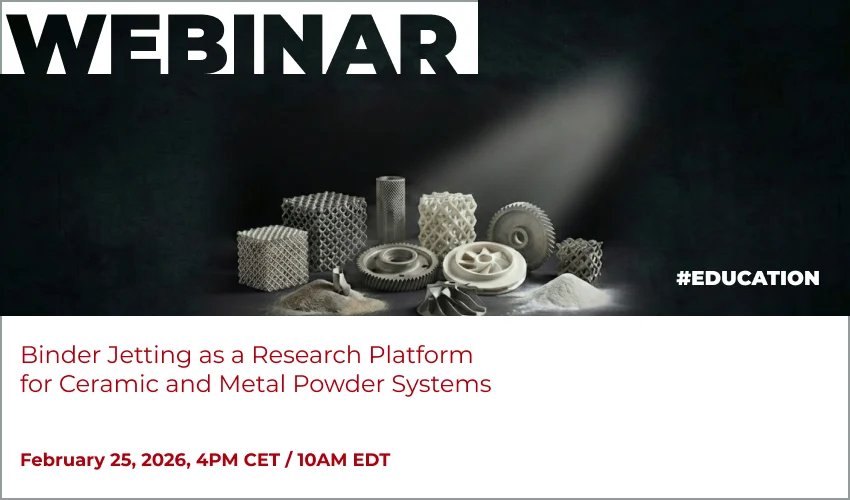
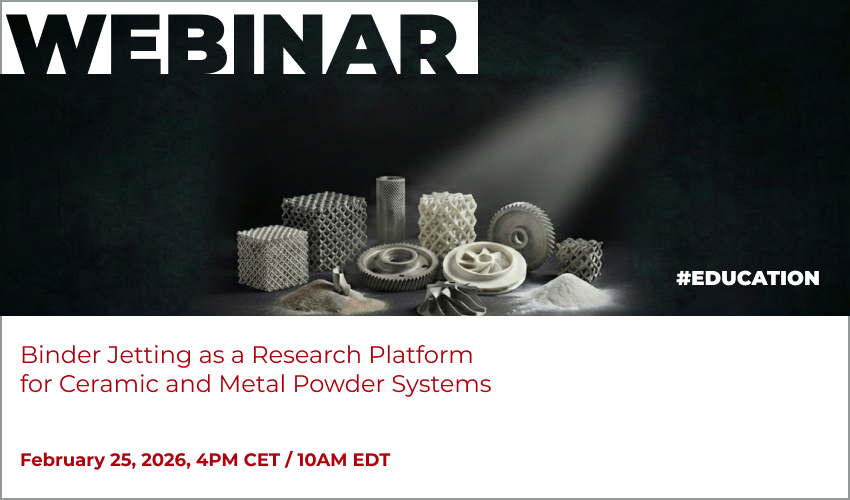
Binder jetting is increasingly emerging as a powerful research platform for advancing ceramic and metal powder systems. Beyond industrial production, the technology offers unique advantages for material development, process exploration, and experimental flexibility, making it especially relevant for academic and research environments. Its ability to handle a wide array of powders makes it an ideal sandbox for exploring novel material compositions and complex geometries that are otherwise difficult to fabricate.
In this webinar, you will hear from a research scientist and engineer from Arc Impact, as well as a senior application engineer from the University of Applied Sciences and Arts of Southern Switzerland (SUPSI). Together, they will examine the mechanical and chemical advantages that make binder jetting a viable tool for formal research. The session will conclude with an interactive Q&A, providing a direct forum to discuss technical hurdles and research questions with our guest experts.
Register for free HERE. The webinar will take place on Wednesday, February 25, 2026, at 4 PM CET / 10 AM EDT.
Speakers
Federico Ferrari – Regional Technical Manager at Arc Impact
Federico Ferrari holds a degree in mechanical engineering from the University of Parma. He has eight years of experience in metal AM (L-PBF and binder jetting) on applications in various sectors. He has worked in innovative startups and service bureaus, and has been employed at Desktop Metal since 2022 as Regional Technical Manager for metal and ceramic binder jetting solutions.
Benjamin Groth – Research Scientist at Arc Impact
Dr. Groth has a PhD in Materials Science from Rutgers University, where his focus was on residual stress analysis of dense carbide materials. He joined Arc in January of 2021 (as ExOne, prior to DM/Arc acquisition), to develop capabilities in printing and densifying ceramic materials for a variety of end users and applications. Prior to this, Dr. Groth spent 9 years working as a Senior Research Engineer for a leading refractories company serving the non-ferrous foundry industry. In this role, he developed metal treatment, transfer, and holding products, as well as researching sensor technologies to aid aluminum metal casting.