

Trade is a hot topic with a lot of uncertainty. Trade policy decisions being made in Washington will impact farmers and ranchers in the countryside. This Market Intel report is the first in a series exploring different topics related to agricultural trade, including the potential impacts of trade policy changes.
With more than 20% of U.S. agricultural production destined for foreign markets, agricultural exports are vital to the financial success of U.S. farmers. Exports not only allow U.S. farmers to find additional customers among the over 95% of the world population that lives outside of our borders but also add value for farmers as many foreign customers are looking for products for which Americans find little or no value. For instance, consumers in Japan, South Korea and other Asian countries are willing to pay premiums for fruit; and while certain animal parts, such as beef tongue or chicken feet, are undesirable in the United States, they are delicacies in other cultures, and so add value to U.S. production through trade.
Agricultural exports are also important the broader U.S. economy. On average, $2.09 of domestic economic activity is created for every $1 of U.S. agricultural exports. This translates to jobs as well, with USDA estimating that over 6,000 jobs are created for each $1 billion in agricultural exports – equaling approximately 1.25 million jobs in 2022.
Where We Export
In 2024, the U.S. exported $176 billion in agricultural products to a total of 189 countries and territories. However, 75% of our total exports went to only 10 markets and nearly half (47%) of our agricultural exports went to only three countries: Mexico, Canada and China. Mexico became the top destination for U.S. agricultural products for the first time in 2024. Between 2003 and 2023, the top spot alternated between China (2012-2014, 2016, 2020-2023) and Canada (2003-2011, 2015, 2017-2019).
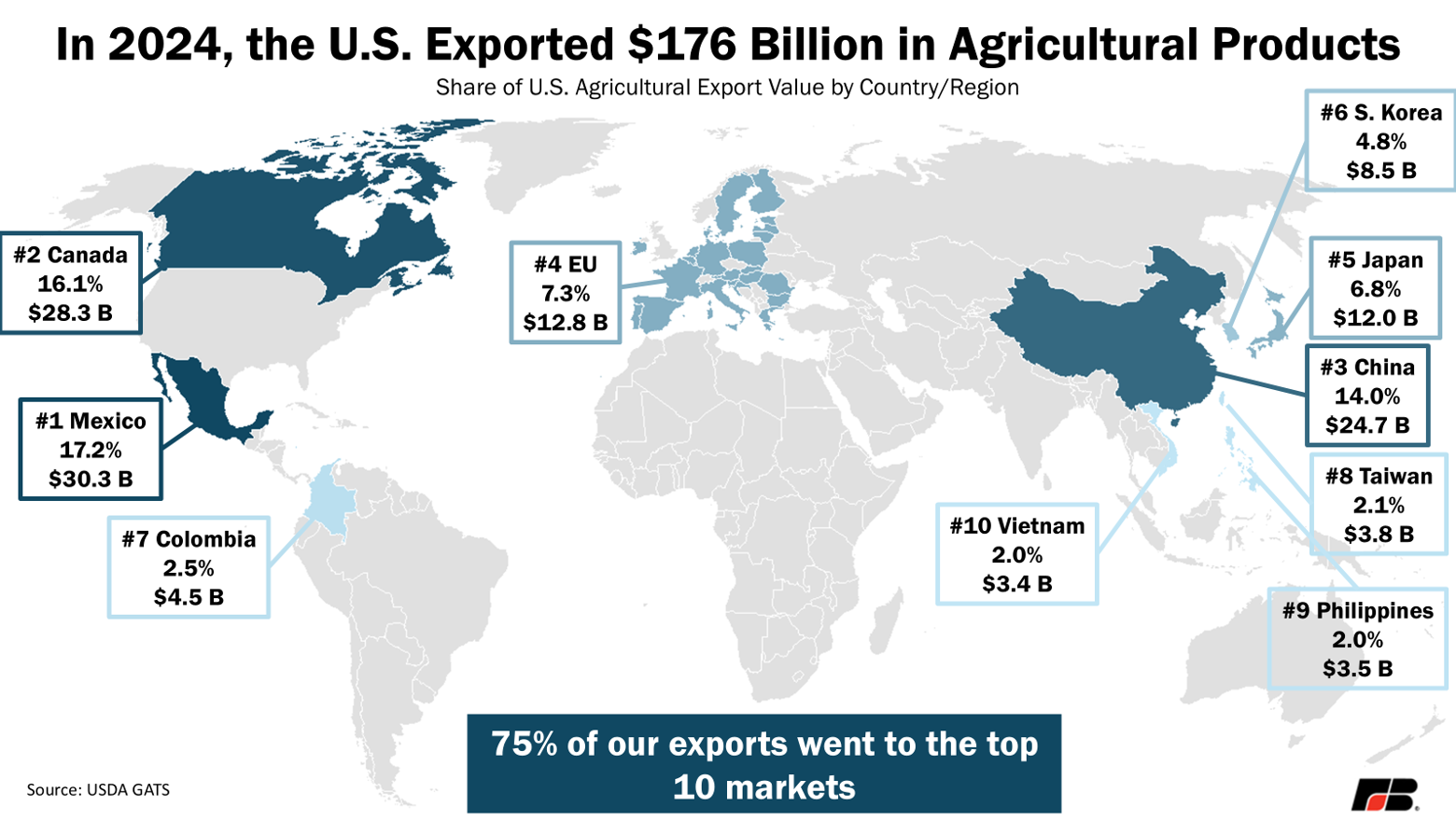
Additionally, nearly half of all agricultural exports (49%) go to markets with whom the U.S. has a free trade agreement. This is a new record, and interesting as we have not signed an FTA with a new partner since 2012, when agreements with South Korea, Colombia and Panama entered into force.
What We Export
What we export is determined by a multitude of factors. Of course, there is geography and climate, which determine where and what we can grow. While the Corn Belt has some of the world’s richest farmlands and ideal growing conditions for its namesake corn, we can only grow extremely limited amounts of such tropical products as coffee and bananas in Hawaii and Puerto Rico. Economics is also at play. Labor is expensive in the United States as compared to other nations, leading U.S. farmers to specialize in crops that can be mechanically harvested: row crops and tree nuts.
With that in mind, let’s dive into what we export. By value, 48% of agricultural products we exported in 2024 were in the consumer-oriented products category, which includes products you would find at the grocery store like meat, pasta, tree nuts and fresh fruit. Thirty-two percent were considered “bulk,” which generally includes unprocessed, row-crop commodities such as corn, soybeans, cotton and tobacco. Intermediate products, which include processed commodities such as soybean meal, ethanol and seeds for planting, were 19% of the total in 2024.
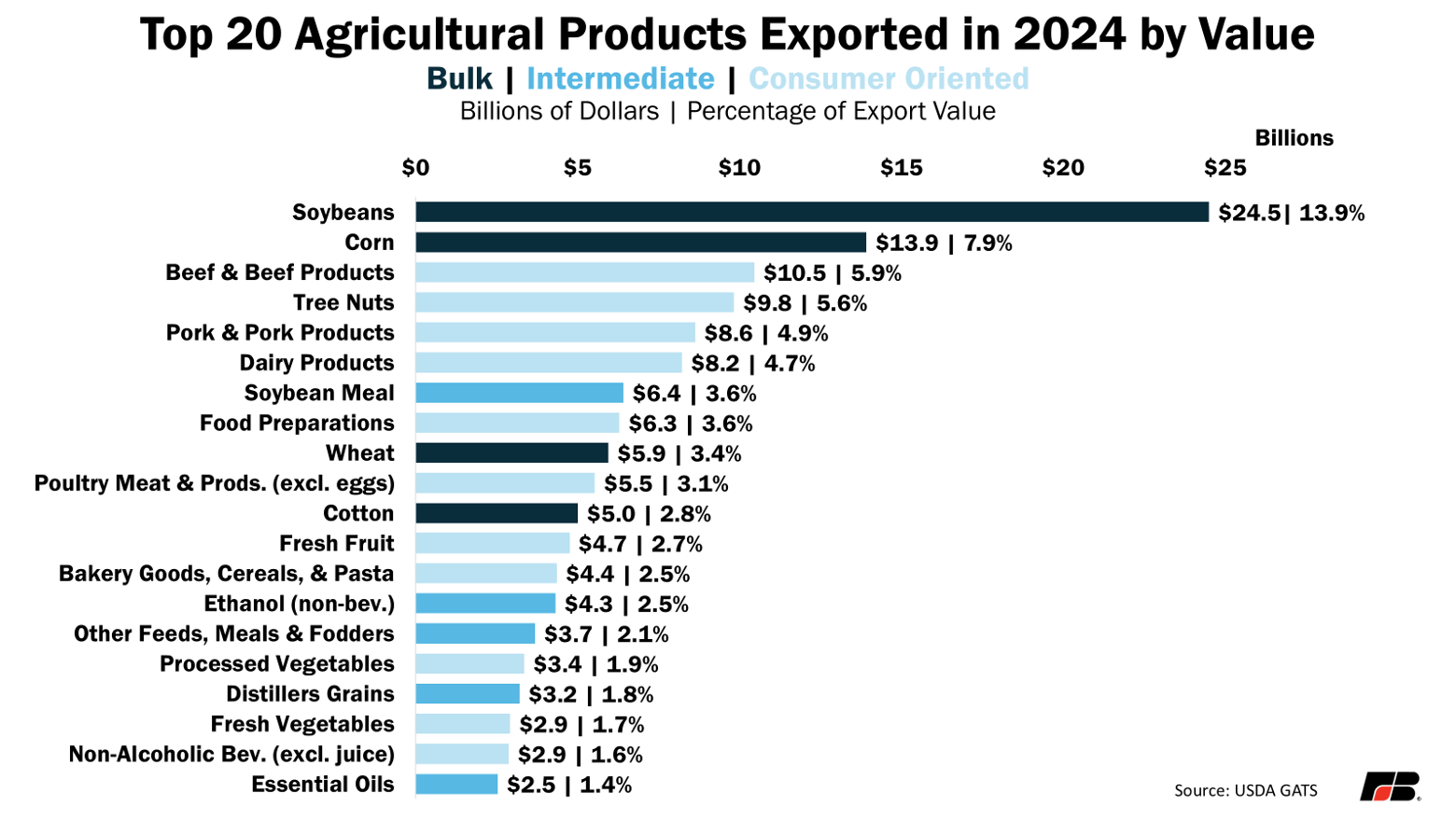
Despite low commodity prices, soybeans and corn – sold with minimal processing – directly accounted for 22% of all exports by value in 2024 ($38.4 billion). Remember these products also benefit from exports in numerous other ways: as fed to livestock, feedstock for ethanol and as components of alcoholic beverages, among other export products. The U.S. Meat Export Federation estimates 512.7 million bushels of corn and 96.8 million bushels of soybeans were fed to animals eventually exported as beef and pork products in 2023. In 2024, exports of ethanol set a record at 1.9 billion gallons, which at 2.8 gallons per bushel, translates to 684 million bushels of corn. The exports of corn through beef, pork and ethanol alone would increase the amount of corn exported (2.5 billion bushels) by nearly 50%.
Big Picture
Exports are a key component of the success of U.S. farms, accounting for more than 20% of agricultural production by value. In addition, exports are good for the broader U.S. economy, with on average $2.09 of domestic economic activity created for every $1 of U.S. agricultural exports. Agriculture is also a key percentage of overall exports for our country – accounting for 8.4% of goods exported in 2024 and 5.5% of total exports, including services.
Agricultural exports have benefited greatly from the expansion of free trade in recent decades. This also means that when the U.S. restricts trade through tariffs on other countries’ products, U.S. farm and ranch goods are often targeted for retaliatory tariffs or restrictive measures, putting farmers on the front line of many trade disputes and jeopardizing American farmers’ access to critical foreign markets.