

In the Assin Central District of Ghana’s Central Region, cocoa farmers gather not just to discuss yields and prices, but to collectively chart survival strategies against a climate that no longer follows familiar patterns.
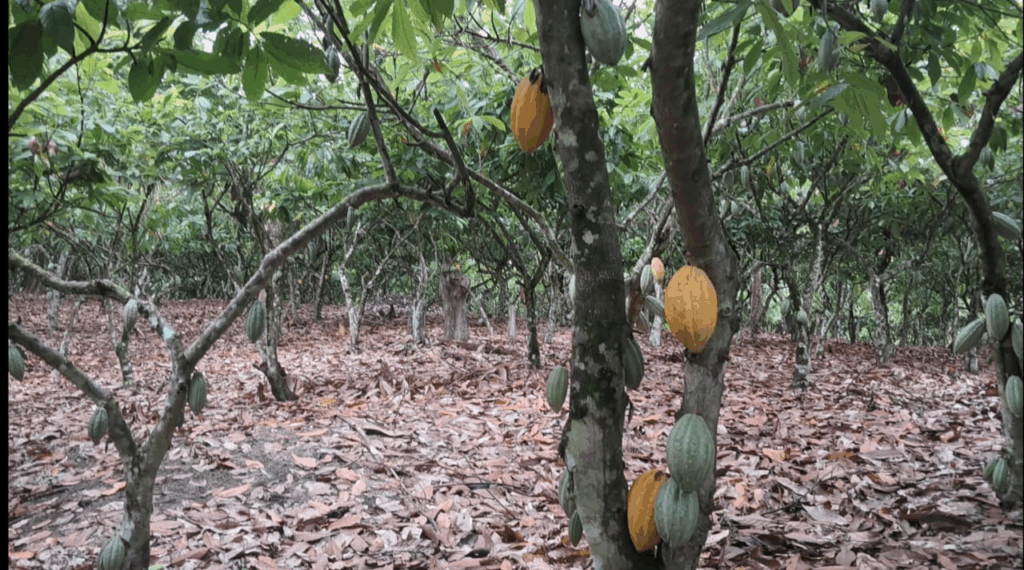
Under the shade of cocoa trees in Assin Fosu, members of a local farmers’ cooperative discuss rainfall forecasts, soil health, and how to safeguard their livelihoods from increasingly unpredictable weather.
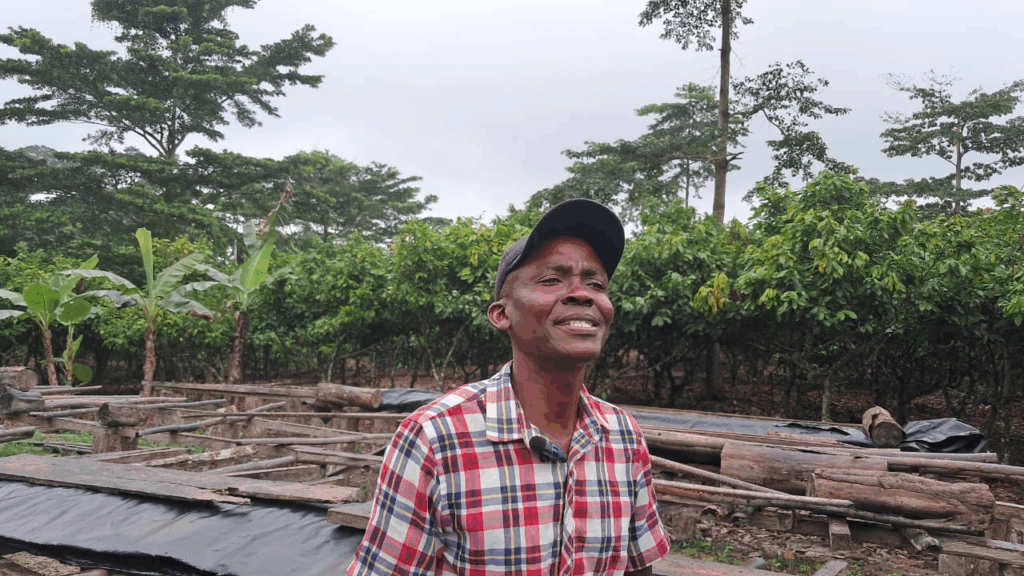
“We cannot continue farming the same way,” says Samuel Torbi, a leader of the Assin Fosu Cocoa Farmers’ Cooperative, a group turning shared vulnerability into collective resilience.
Samuel owns a 17-acre cocoa farm bordering a forest reserve. In good years, his farm produces about 300 bags of cocoa, enough to support his household. After more than 20 years in cocoa production, he says farming has remained his economic backbone. Yet climate change now poses the greatest threat to that stability.
“You’re supposed to plant cocoa in March, but when the dry season extends unexpectedly, the young plants die,” he explains. “Climate change is now our biggest challenge in cocoa farming.”
Across Ghana, climate variability is rewriting the rules of farming. According to the Ghana Meteorological Agency, average temperatures have increased by about 1°C over the past 30 years, while rainfall has become increasingly erratic. The World Bank estimates that climate change could reduce Ghana’s agricultural productivity by up to 7% by 2050 if adaptation measures are not scaled up.
This poses a direct threat to smallholder farmers, who account for over 60% of Ghana’s agricultural workforce and produce nearly 80% of the country’s food, according to the Ministry of Food and Agriculture (MoFA).
In regions such as the Upper East, Northern, Bono, Ahafo, and parts of the Central, prolonged dry spells, flash floods, and soil degradation are driving down yields, raising production costs, and deepening food insecurity.
Cocoa, Ghana’s leading agricultural export and a livelihood for over 800,000 farm families, is particularly vulnerable.
Cooperatives as engines of climate adaptation
Amid these challenges, agricultural cooperatives are emerging as a quiet but powerful force in Ghana’s climate response. Once viewed primarily as vehicles for market access and bargaining power, cooperatives are increasingly functioning as hubs for climate-smart agriculture, information sharing, and risk management.
Agricultural researchers note that farmer-based organisations are gaining relevance because they provide a structured platform for engagement with government agencies, research institutions, and development partners.
Dr Victor Owusu, Senior Lecturer at the Department of Geography Education, University of Education, Winneba, whose research focuses on agrarian food systems and livelihood resilience, describes climate change as a planning nightmare for farmers.
“The erratic nature of the weather makes agricultural planning extremely difficult,” he says. “This is where cooperatives become critical. While climate science informs policy, farmers also possess indigenous knowledge that has sustained their livelihoods for generations. Cooperatives create a space where scientific knowledge and local experience can work together.”
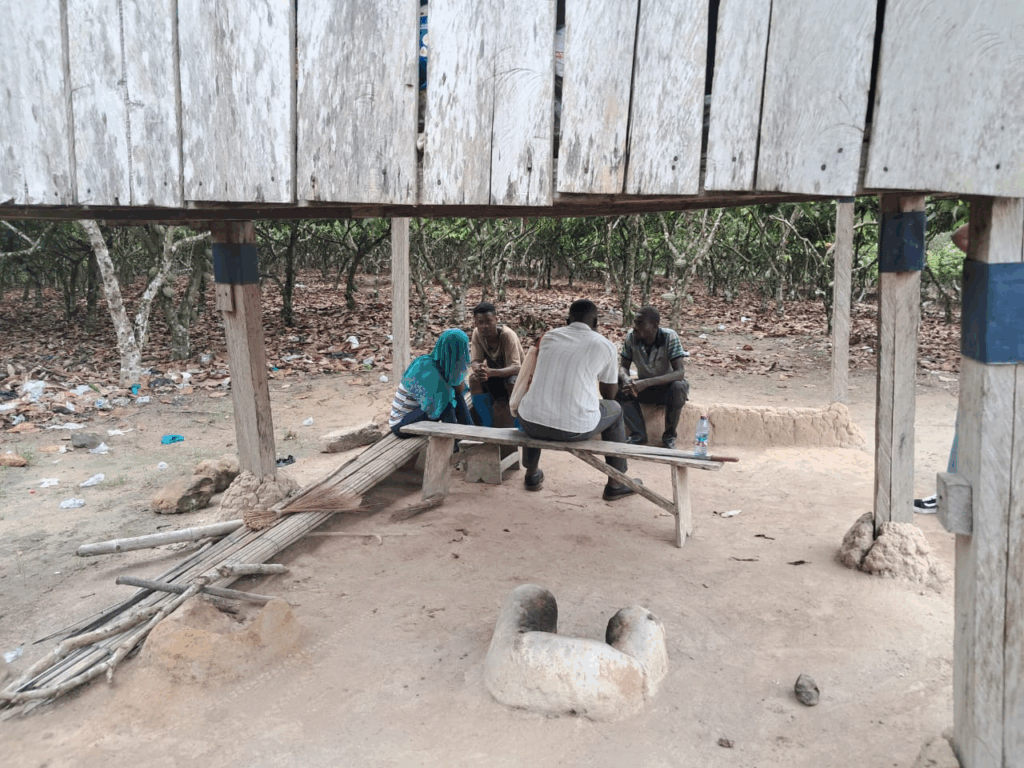
In Assin Fosu, change began with targeted training sessions supported by the Ministry of Food and Agriculture (MoFA), the Ghana Cocoa Biard (COCOBOD), and local NGOs. Farmers were introduced to climate-smart agriculture (CSA) practices such as mulching, crop rotation, shade tree integration, improved seed selection, composting, and rainwater harvesting.
Abdul Rahman Ayiku Tetteh, the Pruning, Irrigation and Cocoa Management Systems Coordinator at the Cocoa Health and Extension Division (CHED) of COCOBOD, describes cooperatives as essential allies in reaching farmers efficiently.
“Climate change is affecting production and wellbeing,” he explains. “We educate farmers on planting disease-resistant varieties, integrating shade trees, and protecting cocoa from direct sunlight. When cooperatives are involved, information spreads faster and adoption rates improve.”
CHED estimates that farms practicing recommended shade management and pruning techniques can improve productivity by 15–25%, even under climate stress.
The Assin Fosu cooperative has 72 active members, meeting monthly to review production data, welfare concerns, and business performance. Special farmer business schools provide hands-on training in climate-smart practices.
“We now understand that cutting down trees worsens climate stress on cocoa,” Mr. Torbi explains. “Shade trees improve soil moisture, regulate temperature, and protect yields.”
Beyond agronomy, the cooperative has introduced group savings schemes, bulk input purchases, and shared irrigation support, reducing individual costs by up to 20%, according to members.
“Before, I couldn’t afford fertiliser,” says Sala Iddrisu, a cocoa farmer and mother of two. “Now we buy together and support each other.”
Some members have also committed portions of their land to tree planting and carbon sequestration initiatives under REDD+ programmes, contributing to Ghana’s emission reduction targets while restoring degraded landscapes.
Policy shift toward bottom-up solutions
Experts say cooperatives are central to scaling climate adaptation across the country.
According to Dr Victor Owusu, for decades, agricultural governance in Ghana has largely followed a top-down model, limiting local participation in policy design and implementation.
“We’ve realised that the top-down approach towards dissemination of information, such as climate change, availability of subsidies for farmers, including fishers, there’s a big gap communication gap, most of the information or the intended materials do not get to the people who are supposed to be using this information and other materials for their work to benefit their welfare.
“So gradually, we are moving towards a bottom-up approach where government and other agencies are now recognizing the importance of empowering local cooperatives to also be actively involved in the management and governance of agriculture, food value chain,” he observed.
Ghana’s Updated Nationally Determined Contributions (NDCs) and the Climate Resilient and Green Economy Strategy explicitly recognise farmer-based organisations as key actors in adaptation and mitigation efforts.
However, challenges remain. Access to climate finance, long-term technical support, and research partnerships continues to constrain cooperative growth.
Dr Owusu says empowering farmer-based organisations and local cooperatives will get them more involved in the management of the food value chain, especially in taking interest in climate change and its ramifications on the local agriculture sector.
“The agriculture sector is directly under the mercy of climate change, because we talk about farming, they depend on the mercies of the weather; the rainfall and the temperature. When we talk about the fishing, it’s also the same.
“So information dissemination is very important, when we are talking about climate change and climate information, so that these farmers will be able to use this information for their planting season and other important information that will help them to sustain their various businesses,” he stated.
Back in Assin Fosu, farmers are preparing for the next planting season. They are testing cover crops to restore soil fertility, composting organic waste, and experimenting with drought-tolerant cocoa seedlings.
“We are no longer just surviving,” Mr Torbi says. “We are adapting and leading.”
As climate change tightens its grip on Ghana’s food systems, one lesson is becoming increasingly clear: resilience is not built solely through technology or central policies, but through empowered communities working collectively.
In that future, agricultural cooperatives are not just participants; they are climate champions, shaping sustainable pathways for rural Ghana.
This article is written as part of a collaborative project between JoyNews, CDKN Ghana, and the Centre for Climate Change and Sustainability at the University of Ghana, with funding from the CLARE R41 Opportunities Fund
DISCLAIMER: The Views, Comments, Opinions, Contributions and Statements made by Readers and Contributors on this platform do not necessarily represent the views or policy of Multimedia Group Limited.
DISCLAIMER: The Views, Comments, Opinions, Contributions and Statements made by Readers and Contributors on this platform do not necessarily represent the views or policy of Multimedia Group Limited.
Source link