
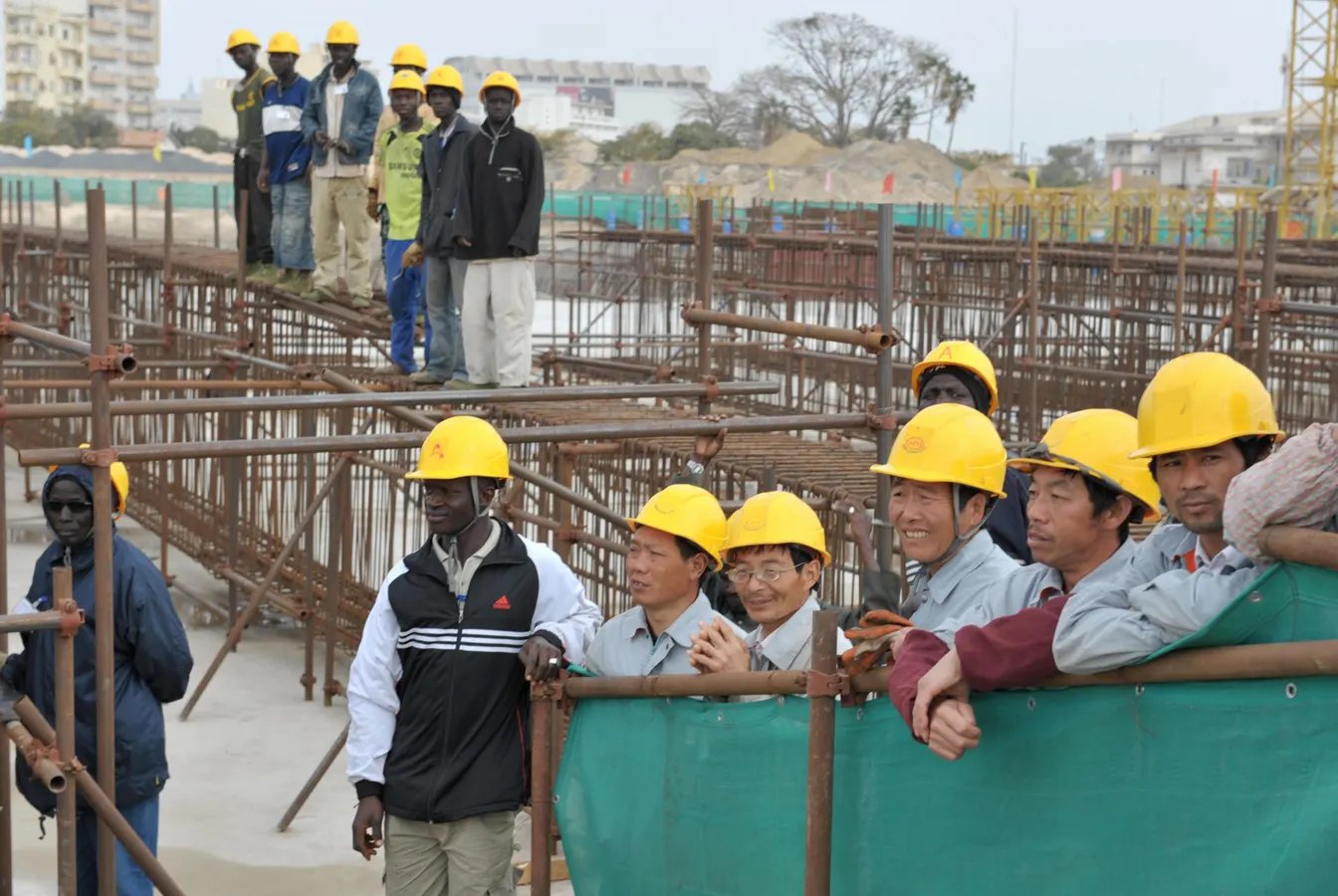

Seneglese and Chinese workers observe a ceremony at the national theater construction site financed by China on February 14, 2009 in Dakar, during a visit by Chinese president Hu Jintao and Senegalese president Abdoulaye Wade. Joint projects such as this have defined the BRI, but have now invited backlash and reorientation.
AFP via Getty Images
Over the past decade, China has entrenched itself worldwide through the Belt and Road Initiative (BRI) by building extensive transport, energy, and industrial infrastructure and becoming a leading trading partner and creditor by the mid-2020s. Yet the BRI model, centered on state-backed lending, opaque contracting, and the export of excess Chinese industrial capacity, has revealed structural weaknesses that motivated the creation of BRI 2.0. Rising debt burdens, environmental damage, limited participation of local firms, and increasingly negative public sentiment have generated demand for alternatives.
Recognizing the impracticality of competing with China on infrastructure, the United States has adopted an asymmetric strategy. Rather than replicating Beijing’s capital-intensive approach, Washington has leveraged its comparative advantages in soft infrastructure, technology, standards, and institutional capacity. Rather than building a hospital or reservoir, America could train nurses or engineers. The G7’s Partnership for Global Infrastructure and Investment (PGII) has become the primary vehicle for this strategy to compete with China.
While the advantages of PGII and BRI are being revealed through international competition, energy infrastructure and dynamics complicate previous assumptions on the BRI and PGII. The Trump administration’s unabashed embrace of hydrocarbons has translated into an open desire to accelerate funding for energy infrastructure as part of America’s foreign policy, thereby violating the asymmetrical foundation of the PGII. China, which is trying to lessen its dependence on vulnerable energy imports, is more interested in building dependence on Chinese green-tech exports and Chinese norms. This awkwardly puts Chinese and American energy strategies at odds with their own global infrastructure initiatives.
The Frontier Of Sino-American Competition
There is no better bellwether for the status of Sino-American competition, especially in energy infrastructure, than Central Asia. Central Asia is where China first unveiled BRI and launched BRI 2.0, and it’s no coincidence that Central Asia was the first place Xi Jinping traveled to after COVID-19 ended. It’s also a region where historic tensions have compelled Beijing to tread lightly. For the United States, Central Asia is boxed in by Russia, China, Iran, and Afghanistan, with Europe and India as near-neighbors. This makes Central Asia key for American geopolitical initiatives.
Infrastructure, especially energy infrastructure, remains the central instrument of geo-economic influence in Central Asia, beyond norms-building or high-tech. China continues to prioritize the construction of roads, railways, and pipelines to secure export routes and energy supplies. By contrast, the United States and its G7 partners have focused on optimizing existing infrastructure, reducing logistical bottlenecks, and integrating Central Asia into global supply chains that bypass both Russia and China.
The Trans-Caspian International Transport Route (TITR), or “Middle Corridor,” has emerged as a critical artery linking Central Asia to Europe via the Caspian and South Caucasus. Following the geopolitical shocks of the early 2020s, the Northern Corridor through Russia became commercially and politically untenable for many firms, dramatically increasing the strategic value of the Trans-Caspian route.
Traffic growth along the Middle Corridor has been rapid. In the first eleven months of 2024, cargo volumes along TITR reached 4.1 million tons, a 63 percent increase year-on-year, while container shipments rose 2.6-fold to more than 50,000 TEU. However, much of this growth has been driven by Chinese transit: China–Europe shipments increased more than fourteenfold. In effect, Beijing has used Western-supported upgrades to incorporate the Middle Corridor into the broader BRI ecosystem.
This is an unusual situation. Usually, it’s Western actors using Chinese infrastructure to advance their own interests. Washington’s response has been to seek a functional rather than physical reorientation of the corridor. In 2025, the United States integrated TITR into the Trump Route For International Peace and Prosperity. TRIPP, the American corridor through Armenia linking disjointed sections of Azerbaijan, is part of both the Azeri-Armenian peace process and a supplemental route for TITR.
The TRIPP framework aims to shift the route’s purpose away from Chinese transit and toward the export of Central Asian resources and finished goods, such as uranium, tungsten, fertilizers, and agricultural products, to Western markets. TRIPP also emphasizes European energy security through routes that bypass Russia and Iran and promotes the adoption of Western-aligned digital logistics systems as an alternative to China’s LOGINK platform.
A Chinese military nurse onboard of the Chinese hospital ship Peace Ark for humanitarian medical service between People’s Republic of China and the Republic of South Africa in Cape Town harbor for exercises on August 26, 2024. Despite China’s belated efforts to embrace American-style service diplomacy, observable impact continues to lag behind Washington.
AFP via Getty Images
Dueling Asymmetric Strategies
Given the prohibitive costs of building ports and railways from scratch, U.S. and EU efforts have concentrated on soft infrastructure. The U.S. Department of Commerce’s Trans-Caspian Trade Route program has emerged as a key instrument, advancing a Joint Action Plan focused on three priorities: harmonizing customs procedures, digitizing cargo documentation and tracking, and coordinating end-to-end tariffs across the corridor. Together, these measures address inefficiencies that often delay shipments beyond the physical transit time, while improving transparency and reducing corruption risks.
The contrast in financing models is equally stark. BRI projects rely primarily on sovereign lending from China’s policy or sector-wide banks, often backed by state guarantees or resource collateral. PGII, by contrast, seeks to mobilize private capital through blended finance, grants, and risk-mitigation instruments deployed by institutions such as the U.S. International Development Finance Corporation and EXIM Bank. This approach reduces sovereign debt exposure while aligning projects with greater long-term commercial viability, at the cost of slower project mobilization.
Standards and transparency further differentiate the two models. PGII and G7-backed initiatives impose rigorous anti-corruption safeguards and environmental and social assessments. Chinese projects, by comparison, are frequently governed by closed contracts, limited public disclosure, and weaker environmental requirements.
A second major arena of competition is the digital domain. China has promoted the Digital Silk Road by exporting surveillance technologies, 5G infrastructure, and cloud services. Huawei, benefiting from low costs and preferential financing, dominates much of Central Asia’s telecommunications market. The United States, in response, has advanced a model based on open standards, supplier diversification, and digital sovereignty.
The promotion of Open RAN architecture, allowing operators to mix equipment from multiple vendors, has become central to this effort. Uzbekistan’s mobile operator Perfectum, which selected Nokia with Western financial backing, set a precedent by excluding Huawei from the network core, demonstrating that diversification is politically and commercially feasible.
Satellite communications have further altered the balance. By reducing reliance on terrestrial cables transiting Russia or China, satellite internet directly strengthens regional information sovereignty. Following pilot programs in rural education, Starlink officially launched in Kazakhstan in August 2025, with Uzbekistan expected to follow in 2026.
Competition is now extending into data storage and processing. China is investing in data centers and AI infrastructure under Digital Silk Road 2.0, while the United States is working to integrate Central Asia into global cloud ecosystems led by Microsoft, Google, and Amazon. In late 2025, Kazakhstan announced a $3.7 billion partnership with a consortium of U.S. technology firms to develop AI infrastructure and train specialists, aligning with President Tokayev’s ambition to transform the country into a fully digital economy.
U.S. economic policy toward Central Asia for 2026–2030 increasingly emphasizes partnership over aid, with a focus on job creation, technology transfer, and sustainable growth. This approach contrasts with China’s model, which has reinforced debt dependence and commodity specialization.
Energy Imperatives
Commodity-rich Central Asia has often seen much of its geoeconomic engagement focused on energy and energy infrastructure. The cutting edge of energy, critical minerals, represents one of Washington’s most tangible successes. Through the C5+1 Critical Minerals Dialogue, the United States has prioritized Central Asia’s reserves of uranium, tungsten, lithium, and rare earths. In November 2025, Cove Capital reached a $1.1 billion agreement with Kazakhstan’s Tau-Ken Samruk to develop tungsten deposits, with strong backing from EXIM Bank and DFC. Given that China supplies roughly 80 percent of global tungsten, establishing a major alternative source was a strategic gain, particularly as processing and value-addition will occur domestically in Kazakhstan.
Despite these advances, China remains the largest creditor, with much of this credit bound up in energy infrastructure for several Central Asian states. This creates ongoing vulnerabilities. These countries, especially Kyrgyzstan and Tajikistan, where Chinese loans account for roughly one-third of external debt, face constrained fiscal space and heightened political exposure. While Washington cannot directly refinance these obligations, it has sought to offer an alternative growth model centered on private investment rather than sovereign borrowing.
The B5+1 platform has become a key mechanism in this regard. The upcoming forum in Bishkek in February 2026 will focus on sectors such as e-commerce, tourism, and agribusiness—areas that generate employment more rapidly and with lower capital intensity than large infrastructure projects, helping to ease social pressures from demographic growth.
The principal challenge for the United States remains scale. American initiatives are targeted and selective, while China’s presence is systemic. Long-term success will depend less on memoranda than on rapid, visible implementation that demonstrates commercial viability. Nevertheless, the United States is increasingly positioned to engage China from a position of relative strength, supported by a growing coalition of global and Central Asian partners that view U.S. engagement as both a guarantor of sovereignty and a tool for strategic maneuvering amid global instability.