
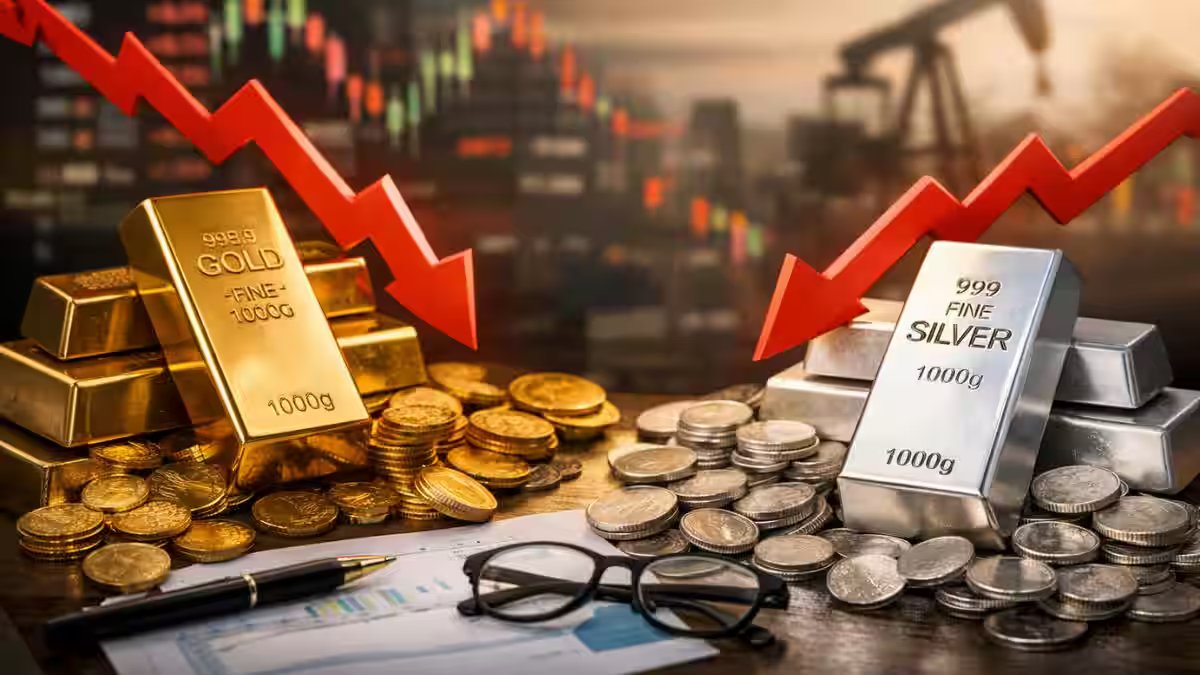
Gold and silver prices witnessed sharp volatility once again, creating confusion among investors and traders. According to market expert Anil Singhvi, the level of fluctuation seen in precious metals over the last few sessions has been unusually high and remains difficult to interpret.
Gold prices have corrected sharply from their 52-week high. MCX Gold February futures had touched a 52-week high of Rs 1,80,779, while the current market price on Monday stands at Rs 1,37,951. This marks an absolute fall of Rs 42,828 from the peak, translating into a decline of about 23.7 per cent. On a one-day basis, gold is down Rs 4,266, or 3.00 per cent.
Silver has seen an even steeper correction. MCX Silver March futures had hit a 52-week high of Rs 4,20,048, while the current market price on Monday is Rs 2,49,713. This is a total fall of Rs 1,70,335 from the high, amounting to a decline of around 40.6 per cent. On the day, silver is lower by Rs 15,939, or 6.00 per cent.

Singhvi said gold prices saw a sharp spike early in the day before giving up most of the gains within a short span. He explained that gold moved sharply higher in the morning trade, translating into a steep rise in rupee terms, but quickly reversed direction and slipped back. Despite the recovery later, prices continued to trade in a very wide range, highlighting extreme volatility.
“Gold traded in a very large range within a short period. Such movement can unsettle even experienced investors,” Singhvi said.
Silver also saw intense action. Singhvi noted that silver prices surged sharply in the early hours, rising by double digits in percentage terms, before correcting significantly within minutes. He said silver traded in a wide range through the session, underlining the unstable market conditions.
“Silver showed even more volatility than gold. A sharp rise was followed by a quick fall, all within a very short time,” he said.
Singhvi pointed out that both gold and silver have corrected sharply from their recent highs. Gold has slipped substantially from its lifetime high, while silver has also fallen significantly from its peak levels. He said such sharp moves reflect uncertainty across global markets.
According to Singhvi, the current volatility is not limited to precious metals alone. He said industrial metals have also come under pressure amid global uncertainty. Copper has declined notably from its top, while aluminium saw its steepest single-day fall in many years. Zinc, which had remained firm for several sessions, has also started to weaken.
“There is uncertainty across asset classes. Commodities, currencies and metals are all reacting to global developments,” Singhvi said.
On investment strategy, Singhvi advised caution. He said investors should avoid taking hasty decisions in gold and silver until prices stabilise. He added that those dealing in the physical jewellery market may face wide buying and selling spreads due to rapid price changes.
“It is better to wait for prices to settle before taking any major decision, unless one is actively trading on platforms like MCX,” he said.
Singhvi said work is underway to identify levels where investors who missed earlier opportunities can consider re-entering gold and silver. He stressed that clarity may take some time given the prevailing volatility.
Commenting on metal stocks, Singhvi said further caution is needed in the near term, as global metals may see more downside. However, he said once markets stabilise and a broader recovery begins, metal stocks could emerge as leaders.
“When the next rally comes, metal stocks are likely to lead, but investors should wait for better levels and consider staggered buying,” he said.
On crude oil, Singhvi said prices have eased following signals of possible talks between Iran and the US on a nuclear deal. This has reduced immediate geopolitical risk and led to some cooling in oil prices.
Overall, Singhvi advised investors to stay cautious, avoid panic, and focus on disciplined strategies amid continued volatility in gold, silver and metals.