
Close Menu
Invest Intellect
    Facebook X (Twitter) Instagram
    Invest Intellect
    Facebook X (Twitter) Instagram Pinterest
    • Home
    • Commodities
    • Cryptocurrency
    • Fintech
    • Investments
    • Precious Metal
    • Property
    • Stock Market
    Invest Intellect
    Home»Investments»Why Your Retirement Age Doesn’t Matter (But This Number Does)
    Investments

    Why Your Retirement Age Doesn’t Matter (But This Number Does)

    January 30, 20263 Mins Read


    If you have a target retirement age circled on your calendar, you might be planning around the wrong metric. According to finance expert Dave Ramsey, retirement readiness isn’t determined by hitting 60, 65, or any other birthday milestone. What matters is whether you have accumulated enough invested assets to generate the income you need for the rest of your life.

    The critical question isn’t “Am I old enough to retire?” but rather “Do I have enough money to retire?” Your investment account balance, not your age, determines when you can afford to stop working. Here’s how to calculate your personal financial number.

    Three Methods to Calculate Your Retirement Number

    Method 1: The Precise Budget Approach

    This method delivers the most accurate result but requires detailed planning. Start by estimating your annual retirement spending. Then subtract guaranteed income sources like Social Security.

    For example, if you need $60,000 annually and expect $25,000 from Social Security, your portfolio must generate $35,000 per year. Using the 4% rule (a widely accepted guideline suggesting you can withdraw 4% of your portfolio in year one, then adjust for inflation annually), multiply your income gap by 25. In this case: $35,000 × 25 = $875,000 needed.

    The 4% rule exists because historical market data shows this withdrawal rate has historically sustained portfolios through 30-year retirement periods. With the S&P 500 returning 14.16% over the past year and 86.65% over five years, equity exposure remains crucial for long-term growth, even as 10-year Treasury yields at 4.26% provide meaningful income from bonds.
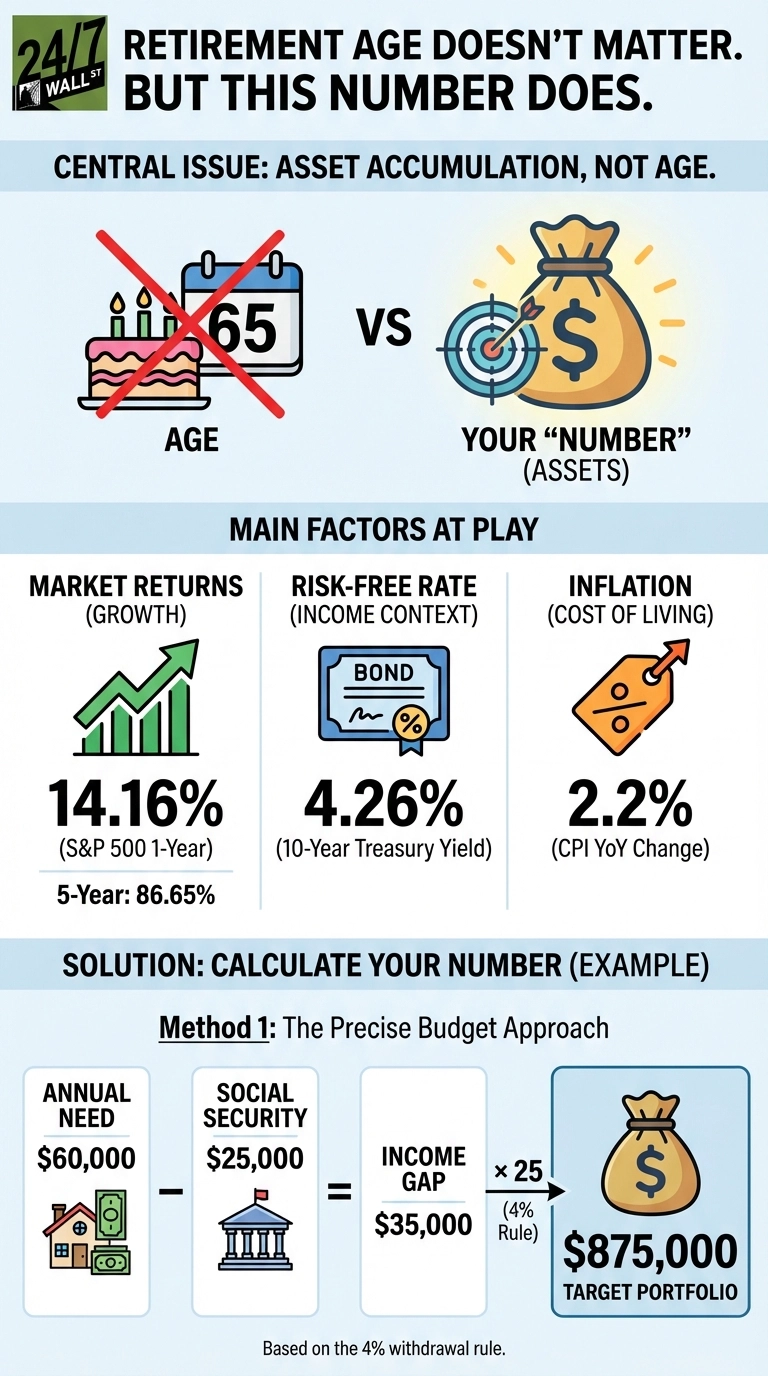

    An infographic titled 'Retirement Age Doesn't Matter. But This Number Does.' It features a light blue and white color scheme. The top section, 'Central Issue: Asset Accumulation, Not Age,' visually contrasts a crossed-out calendar with '65' and a birthday cake (representing Age) against a money bag inside a target (representing 'Your Number' - Assets). The middle section, 'Main Factors at Play,' displays three data points: Market Returns (Growth) with a green upward bar chart, showing S&P 500 1-Year at 14.16% and 5-Year at 86.65%; Risk-Free Rate (Income Context) with a bond icon, showing 10-Year Treasury Yield at 4.26%; and Inflation (Cost of Living) with a price tag icon, showing CPI YoY Change at 2.2%. The bottom section, 'Solution: Calculate Your Number (Example),' presents 'Method 1: The Precise Budget Approach.' It illustrates a calculation: Annual Need of $60,000 (represented by a house and cash) minus Social Security of $25,000 (represented by a government building) equals an Income Gap of $35,000. This Income Gap is multiplied by 25 (labeled '4% Rule') to arrive at a Target Portfolio of $875,000 (represented by a money bag). The infographic concludes by stating it is 'Based on the 4% withdrawal rule.'

    24/7 Wall St.

    This infographic explains why asset accumulation, rather than age, is the key to retirement, illustrating the main financial factors at play and providing an example for calculating your target retirement portfolio.


    Method 2: Income Replacement Ratio

    If you’re years away from retirement and can’t predict exact expenses, assume you’ll need 70% to 90% of your pre-retirement income. Someone earning $50,000 who wants to replace 90% would need $45,000 annually. After subtracting Social Security, multiply the remaining gap by 25 to find your target nest egg.

    Method 3: The 10x Rule

    The simplest approach: multiply your final working salary by 10. Earning $100,000 when you retire means targeting a $1 million portfolio. While less precise than budget-based calculations, this rule of thumb provides a quick benchmark for younger savers.

    Which Method Should You Use?

    Your life stage determines the best approach. Those within five years of retirement should use Method 1 for precision. Mid-career professionals can rely on the income replacement ratio, while younger workers might start with the 10x rule and refine their target as retirement approaches.

    Ramsey’s core insight stands: age is irrelevant if you lack sufficient assets. A 55-year-old with $1.5 million invested is more retirement-ready than a 67-year-old with $200,000. The number in your investment accounts, not the number of candles on your birthday cake, determines when you can afford to stop working. If you haven’t hit your target, the answer isn’t to retire anyway but to keep building your nest egg until the math works in your favor.


    Source link

    Share. Facebook Twitter Pinterest LinkedIn Tumblr Email

    Related Posts

    Lifetime Isa retirement plan could be dropped by government in favour of a new home-buying Isa

    Investments

    Cat bonds remain favoured due to their liquidity and more standardised structure: Howden Re

    Investments

    Foreign Bonds Lead US Fixed Income in 2026

    Investments

    Bonds End Up Little-Changed. Other Markets May Have Helped

    Investments

    These bonds trounced cash in 2025, and they could still offer solid returns for investors

    Investments

    A Retirement Fix For 69 Million American Workers: Australia Inspired

    Investments
    Leave A Reply Cancel Reply

    Top Picks
    Commodities

    Women Earn Just 30% of Agricultural Output, Minister Reveals

    Commodities

    Kendal metal detectorists find live hand grenade in Flookburgh

    Cryptocurrency

    Understanding the Foundations of Digital Currency

    Editors Picks

    Trump admin cancels $1 billion for WA energy projects, Pacific NW Hydrogen Hub

    October 2, 2025

    Go Green For Agricultural Investment And Development: Recommandations des Analystes et Opinions des Brokers | GGRN | EGS07DR1C012

    June 1, 2025

    Transcript : Tube Investments of India Limited, Q4 2025 Earnings Call, May 16, 2025

    May 16, 2025

    Mary Earps ‘postpones Wembley farewell’ after dramatic retirement before Euros triumph

    October 29, 2025
    What's Hot

    Banks May Provide Cryptocurrency Transaction and Custody Services, but OCC Has Yet to Provide Clear Compliance Requirements | McGuireWoods LLP

    May 12, 2025

    Utilities May Charge Public to Offer Discounts for Big Tech, HLS Report Finds | News

    March 31, 2025

    US futures take a post-ASML pause with fresh earnings on deck

    October 16, 2024
    Our Picks

    Four Corners Property Trust annonce l’acquisition d’un bien immobilier de Caliber Collision pour 4,2 millions de dollars

    May 23, 2025

    “les ETF ont montré une certaine résilience”

    May 20, 2025

    Ghana gold mine dispute escalates after takeover

    September 10, 2025
    Weekly Top

    Silver crashes 24%, gold slides 9% in sharp MCX futures sell-off

    January 30, 2026

    Type One Energy initiates licensing of fusion power plant

    January 30, 2026

    Lifetime Isa retirement plan could be dropped by government in favour of a new home-buying Isa

    January 30, 2026
    Editor's Pick

    Limassol’s Booming Real Estate Market Attracts More Property

    October 25, 2024

    AI-powered cloud mining offers investors a new approach to locking in returns.

    October 14, 2025

    StarkFlight’s Annual Agriculture Report Shows Global Agricultural Drone Industry Booming

    May 29, 2025
    © 2026 Invest Intellect
    • Contact us
    • Privacy Policy
    • Terms and Conditions

    Type above and press Enter to search. Press Esc to cancel.