
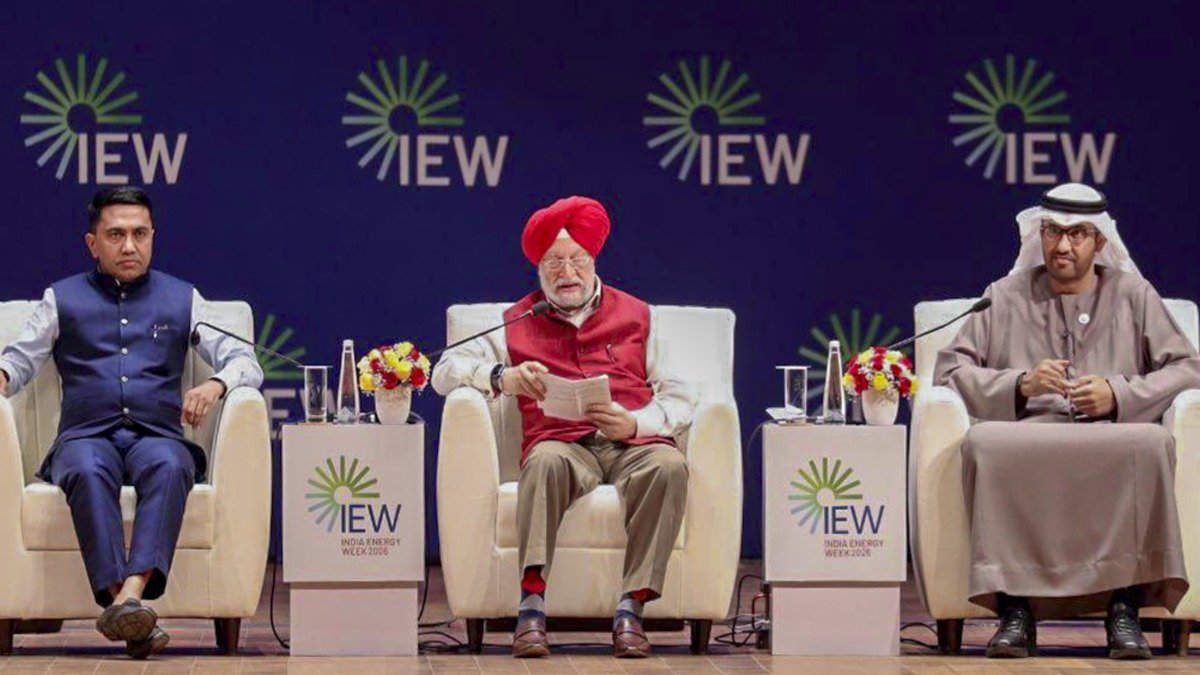
India
oi-Oneindia Staff

India
Energy
Week
(IEW)
2026,
the
four-day
global
energy
conclave,
opened
in
Goa
on
January
27,
marking
yet
another
step
in
India’s
emergence
as
a
central
voice
in
global
energy
conversations.
Over
the
past
few
years,
India
Energy
Week
has
evolved
into
a
truly
global
platform.
It
brings
together
policymakers,
producers,
consumers,
investors,
and
technology
leaders
at
a
time
when
the
global
energy
system
is
facing
unprecedented
pressure-from
rising
demand
and
climate
commitments
to
geopolitical
uncertainty.
For
India,
the
significance
of
hosting
such
a
forum
goes
far
beyond
symbolism.
India
Energy
Week
(IEW)
2026,
a
four-day
global
energy
conclave
held
in
Goa
on
January
27,
highlighted
India’s
advancements
in
energy
security
and
transition,
led
by
Union
Minister
of
Petroleum
and
Natural
Gas
Shri
Hardeep
Singh
Puri,
with
discussions
on
sustainable
investment
in
various
energy
sources
and
the
India-UAE
energy
partnership.
The
event
showcased
emerging
energy
technologies
like
green
hydrogen
production,
solar
power,
battery
storage,
and
nuclear
reactors.

Why
Does
India
Energy
Week
Matter?
The
benefits
of
IEW
for
India
are
tangible.
The
platform
allows
the
country
to
present
its
reform-driven
energy
journey
to
the
world.
With
landmark
policy
reforms
that
allowed
the
country
to
offer
large
sedimentary
basins
for
exploration
in
successive
Open
Acreage
Licensing
Policy
(OALP)
and
Discovered
Small
Fields
(DSF)
bidding
rounds,
India
is
signalling
policy
stability
and
investment
readiness.
Expanded
LPG
coverage
and
improved
access
to
clean
cooking
fuels
further
underline
India’s
focus
on
inclusive
growth.
Addressing
the
inaugural
session,
Union
Minister
of
Petroleum
and
Natural
Gas
Hardeep
Singh
Puri
underlined
India’s
steady
progress
towards
energy
security,
self-reliance,
and
climate
justice
under
the
leadership
of
Prime
Minister
Narendra
Modi.
He
emphasised
that
the
global
energy
transition
is
not
about
replacing
one
source
with
another
overnight,
but
about
adding
energy
responsibly-through
sustained
investment
in
oil
and
gas,
biofuels,
green
hydrogen,
LNG,
and
clean
cooking
fuels.
This
balanced
approach,
he
noted,
is
essential
for
availability,
affordability,
and
sustainability.
The
Union
Minister
stressed
that
India’s
success
in
striking
the
delicate
balance
was
a
ready-template
for
the
world
to
learn
from
and
replicate.
Minister
of
Industry
and
Advanced
Technology
and
ADNOC
MD
and
Group
CEO
Sultan
Ahmed
Al
Jaber
echoed
this
sentiment,
noting
that
global
energy
demand
is
entering
a
phase
of
large-scale
transformation,
driven
by
emerging
markets
like
India.
The
Minister
cautioned
that
underinvestment
poses
the
biggest
risk
to
energy
security
while
calling
for
balanced
investment
across
all
energy
forms.
His
remarks
also
highlighted
the
strength
of
the
India-UAE
energy
partnership,
built
on
trust,
long-term
commitment,
and
shared
value.
Beyond
policy,
IEW
2026
reflects
a
broader
shift
in
how
India
views
energy-not
as
a
static
resource,
but
as
a
force
in
motion.
Mobility
has
emerged
as
a
defining
theme,
where
energy
meets
the
real
economy.
India’s
growing
movement
of
people
and
goods
demands
integrated
solutions,
not
single-fuel
answers.
Electric
mobility,
liquid
fuels,
alternative
fuels,
and
enabling
infrastructure
must
coexist.
At
the
current
juncture
of
India’s
energy
journey,
India
Energy
Week
is
a
crucial
platform
for
practical,
scalable,
and
inclusive
pathways
that
resonate
far
beyond
its
borders.
Spotlights
Moving
From
Labs
To
Real
World
Use
The
event
highlights
a
range
of
emerging
energy
technologies
that
are
steadily
moving
from
research
labs
to
real-world
use.
New
approaches
to
green
hydrogen
production
are
being
showcased,
focusing
on
developing
indigenous
technologies
and
early
storage
solutions
aimed
at
reducing
emissions
in
hard-to-abate
industries.
Advances
in
solar
power,
including
high-efficiency
panels
and
floating
solar
projects,
are
being
tested
under
practical
conditions
to
evaluate
their
performance
at
scale.
At
the
same
time,
battery
storage
systems
combined
with
artificial
intelligence
are
improving
grid
management,
with
pilot
projects
showing
noticeable
reductions
in
power
losses
through
smarter
energy
distribution.
Progress
in
small
modular
nuclear
reactors
and
early-stage
fusion
research
is
also
drawing
attention,
offering
the
promise
of
cleaner
and
more
reliable
base-load
power
in
the
future.