
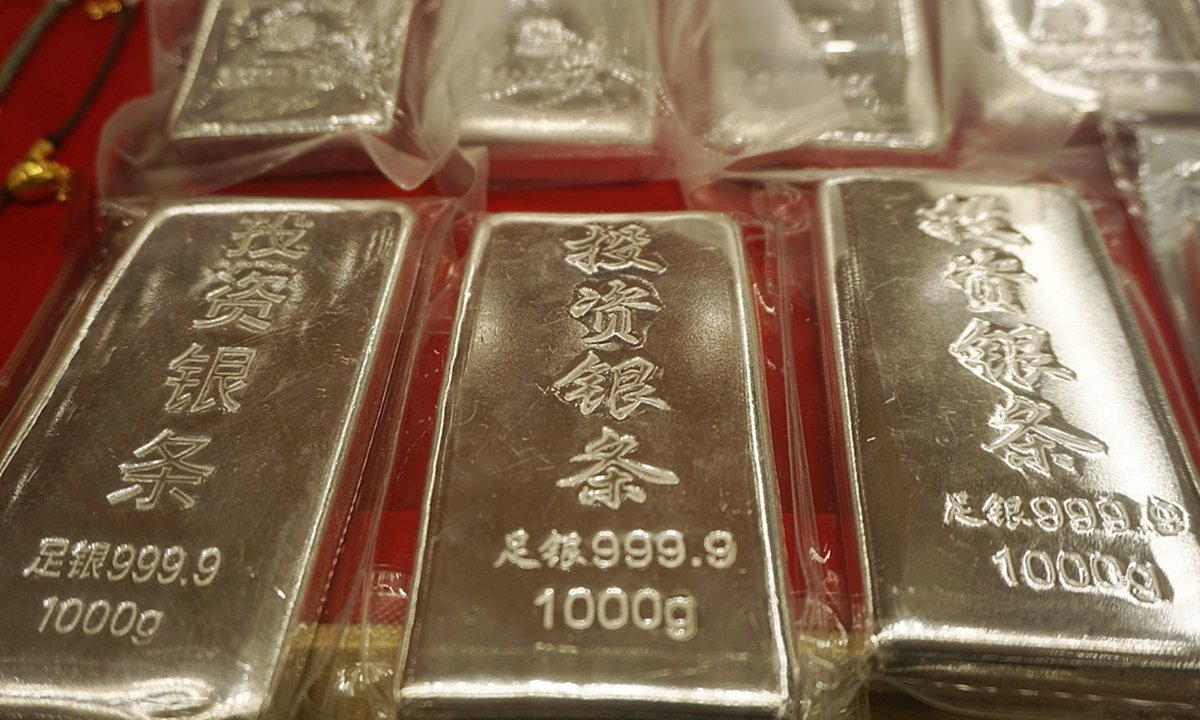
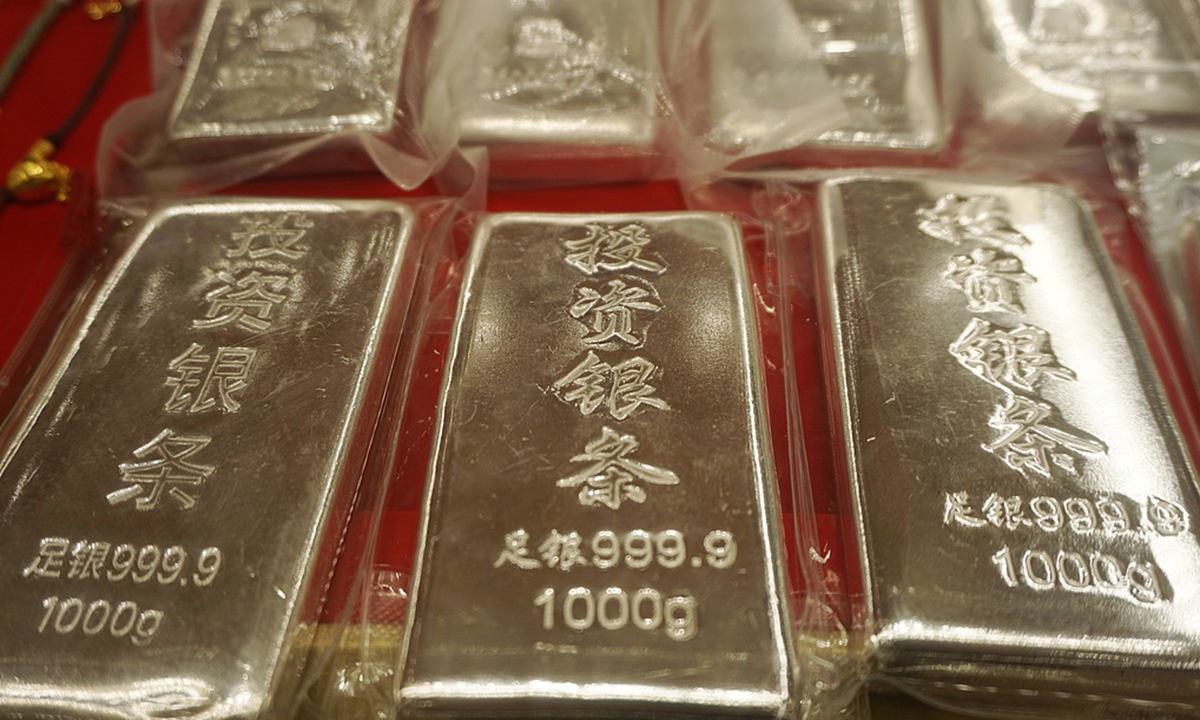
One-kilogram investment silver bars are on display at a gold shop in Hangzhou, East China’s Zhejiang Province on January 15, 2026. Photo: VCG
As metal prices continue to climb, gold and silver prices have repeatedly hit record highs in China, prompting many factories to work overtime to make investment products to meet rising demand. Experts said that the surge in consumption has moved well beyond traditional decorative demand.
The most striking development has been the sharp rise in the prices of silver, which have drawn strong investor interest and left related products in short supply. For example, at an outlet of Hengtai, a company engaged in precious metals sales and buybacks, in Guangzhou in South China’s Guangdong Province, a sales representative said that nearly every customer visiting the store on Sunday had sought investment products, typically purchasing 1-kilogram silver bars.
Notably, at a silver products manufacturing plant in Shenzhen, employees have been working overtime for several consecutive months to produce investment-grade silver bars.
The factory’s manager said that the plant had previously focused mainly on silver jewelry, but demand for investment silver bars had surged in recent months while jewelry demand fell sharply, prompting a shift in production. What was once a side business has now become the factory’s main line of work, according to China Media Group (CMG). To meet the new demand, the plant has added equipment such as hydraulic presses and rolling machines to expand capacity.
During the fourth quarter of last year, production was concentrated mainly on 1-kilogram silver bars, along with some 500-gram and plain-finish products, said Sun Tao, general manager of a silver processing factory, according to CMG. Since this year started, demand has shifted markedly toward smaller bars weighing 100 grams or 200 grams, with improvements across manufacturing techniques and a much wider range of product varieties, Sun added.
Since April 2025, both silver and gold prices have been pushed to sustained historic highs amid fluctuations.
As of press time, data from the Industrial and Commercial Bank of China showed that domestic gold was priced at 1,115.91 yuan ($160.13) per gram, while silver stood at 22.82 yuan per gram.
As precious metal prices continue to hit record highs, copper, which was previously largely overlooked, has also been marketed as an “investment” product. In several jewelry trading hubs, merchants have rolled out copper bars weighing 1 kilogram, quickly fueling a surge in so-called “investment copper bars,” even as industry insiders warned of the risks that accompany the trend.
However, unlike the well-established buyback systems for gold and silver, most vendors selling investment-grade copper bars currently make it clear that they sell but do not repurchase the products, while some offer only consignment services. As a result, individual investors who buy copper bars may face significant difficulties in liquidating their holdings, according to CMG.
Gold and silver are widely regarded as global “hard currencies” offering a certain store of value, particularly gold, which still enjoys relatively solid medium- to long-term support. But price volatility tends to intensify when valuations are elevated and capital flows become highly concentrated, Zhang Yi, CEO and chief analyst at consultancy iiMedia Research, told the Global Times on Sunday.
“By contrast, copper and other non-precious metals primarily function as industrial raw materials, with prices more heavily influenced by industrial cycles and demand conditions, giving them far weaker investment characteristics than gold and silver.”
Zhang cautioned that copper bars or related products marketed as “investment” items often lack the fundamental investment logic of gold or silver, as they are prone to oxidation, involve higher storage costs and offer limited value stability, leaving investors exposed to significant premium risks.
Consumers should therefore be wary of excessive marketing and speculative narratives that inflate the “investment value” of non-gold and non-silver metals during periods of rising prices, he said. Clear distinctions need to be made between industrial and financial attributes, while stronger market guidance and regulation are needed to protect consumers and curb herd-driven investment risks when demand surges.