
What Is a Commodity Market?
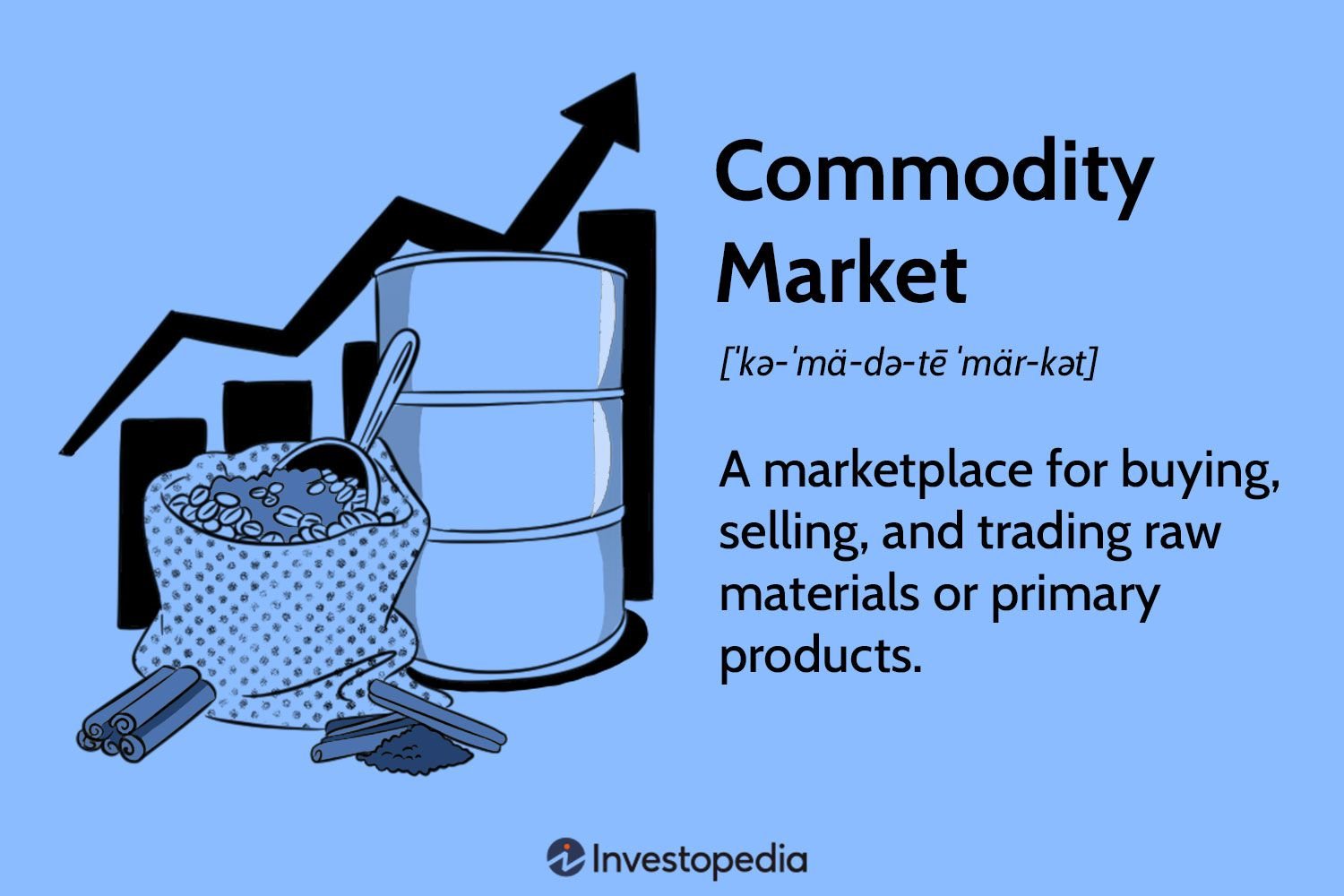
A commodity market is a physical or virtual space for the exchange of raw materials or primary products. These commodities are bought, sold, or traded and are typically natural resources or agricultural products that are largely uniform in quality across producers.
Commodities are goods taken from the earth—from cattle to gold, oil to oranges, and orange juice to wheat. Commodities are transformed into products like baked goods, gasoline, or jewelry, which businesses and consumers then buy and sell. Markets in these goods are the oldest in the world, but they are as crucial to the most modern societies as they were to the small trading communities of ancient civilizations.
Commodities are split into two broad categories: hard and soft. Hard commodities are mined resources like gold, oil, and rubber. Soft commodities include agricultural products like coffee, corn, and wheat. They are traded directly in spot markets or financial commodity markets through contracts for them or their future prices.
Investors profit from the commodity market by buying commodities on the market, investing in companies that produce them, or putting money into futures contracts whose value is derived from changes in their price. Modern economies benefit from the commodity market because it serves as a source of raw materials, hedges against inflation, and is a risk management mechanism for commodity-dependent industries.
Key Takeaways
- Commodity markets trade raw goods like oil, gold, and agricultural products through spot and derivatives markets.
- Commodities are classified as hard (natural resources) or soft (agricultural products and livestock).
- Financial commodity markets use futures and options contracts to manage price risks and speculate on price changes.
- Major U.S. commodity exchanges include the CME, NYMEX, and ICE Futures U.S.
- Commodities can diversify investment portfolios, hedge against inflation, and serve as an alternative asset class.
Zoe Hansen / Investopedia
Understanding the Mechanics of Commodity Markets
Commodity markets have existed since very early in human history. They were and still are found in bustling town squares or along ports where traders and consumers buy and sell grains, haggle over livestock and meat, or try to leave some money to spare to purchase whatever else came in with the harvest. Traditional markets have been the backbone for trading raw materials essential to society.
Alongside these markets, financial commodity markets operate parallel to them. Here, traders don’t swap bushels of wheat or bales of cotton. Instead, they agree on the future prices of these goods through contracts known as forwards, which were standardized into futures and options contracts in the 19th century.
Without these markets, farmers couldn’t ensure they get the prices they need for their harvest to plant seeds the following year. So the regular commodity market is intertwined with trading in the financial commodity markets, which exert extraordinary influence on our daily lives. These financial markets don’t directly handle the commodities themselves—though a trader may be on the hook for delivering them in the future—but enable trading in interchangeable agreements in regulated exchanges. These markets help airlines hedge against rising fuel costs, farmers lock in grain prices ahead of their harvest, and speculators wager on everything from gold to coffee beans.
Producers and consumers can access commodities in centralized, liquid markets. These market actors can also use commodities derivatives to hedge future consumption or production. Speculators, investors, and arbitrageurs (the latter try to profit from small price differences between markets) also play an active role in the commodities trade.
The U.S. Commodity Exchange Act (CEA) from 1936 provides this thorough definition of commodities, which include both physical products and the contracts traded for them:
The term “commodity” includes wheat, cotton, rice, corn, oats, barley, rye, flaxseed, grain sorghums, mill feeds, butter, eggs, Solanum tuberosum (Irish potatoes), wool, wool tops, fats and oils (including lard, tallow, cottonseed oil, peanut oil, soybean oil, and all other fats and oils), cottonseed meal, cottonseed, peanuts, soybeans, soybean meal, livestock, livestock products, and frozen concentrated orange juice, and all other goods and articles, except onions as provided in Public Law 85–839 (7 U.S.C. 13–1), and all services, rights, and interests in which contracts for future delivery are presently or in the future dealt in.
Certain commodities, such as precious metals, are purchased as a hedge against inflation, and the broad set of commodities themselves is an alternative asset class used to help diversify a portfolio. Because the prices of commodities tend to move inversely to stocks, some investors also rely on commodities during periods of market volatility.
Exploring Different Types of Commodity Markets
Commodities trade either in spot markets or financial commodity or derivatives markets. Spot markets are physical or “cash markets” where people and companies buy and sell physical commodities for immediate delivery.
Derivatives markets involve forwards, futures, and options. Forwards and futures are derivatives contracts that rely on the spot prices of commodities. These contracts give the owner control of the underlying asset at some point in the future for a price agreed upon today.
Only when the contracts expire would physical delivery of the commodity or other asset take place, and often traders roll over or close out their contracts to avoid making or taking delivery altogether. Forwards and futures are generally the same, except that forwards are customizable and traded over the counter, while futures are standardized and traded on exchanges.
A commodity option is a financial contract that gives the holder the right, but not the obligation, to buy or sell a specific amount of a particular commodity at a preset price (called the strike price) on or before a specific date (the expiration date).
There are two main types of commodity options:
- Call options: Give the holder the right to buy the commodity
- Put options: Give the holder the right to sell the commodity
These options are used by traders and businesses for various purposes, including the following:
- Speculating on changes in price
- Hedging against price shifts
- Managing risk in commodity-dependent industries
The Evolution of Commodity Markets Through History
Trading commodities goes back to the dawn of human civilization, as loosely affiliated villages and clans would barter and trade with one another for food, supplies, and other items. The rise of empires across the ancient civilizations of Africa, the Americas, Asia, and Europe can be directly linked to their ability to create complex trading systems and facilitate the exchange of commodities across vast territories via major trade routes like the Silk Road.
Today, commodities are still exchanged worldwide—and on a massive scale. Trading has also become more sophisticated with the advent of exchanges and derivatives markets. Exchanges regulate and standardize commodity trading, making trade in these goods and contracts far more efficient.
Fast Fact
The majority of exchanges carry at least a few different commodities, although some specialize in a single group.
U.S. commodity markets date back to colonial times when trade in goods like tobacco, timber, and grains began in centralized marketplaces. Early on, farmers and merchants relied on forward contracts to manage costs when there were problems in supply chains.
The Chicago Board of Trade (CBOT), founded in 1848, standardized how grain futures were traded. Other specialized exchanges arose for cotton, livestock, and metals. These exchanges provided transparency and structure to chaotic markets where “cornering” wasn’t banned until 1868. Shady operations dubbed “bucket shops” preyed on the inexperienced, leading to losses and a lack of faith in the markets. In response, states enacted a patchwork of legislation, including some that banned commodity derivatives (options and futures) altogether.
The Grain Futures Act of 1922 was a turning point. The law established reporting requirements and attempted to limit the massive price fluctuations of the era by mandating that all grain futures be traded on regulated futures exchanges.
During the 1930s, American commodity markets faced many scandals. Speculators fueled wild price swings that threatened to crush farmers and starve those already facing the ravages of the Great Depression. In light of these stark circumstances, the CEA was enacted in 1936. Its most tangible result was establishing the Commodity Exchange Commission (CEC) as an independent agency under the Department of Agriculture.
The CEC was given regulatory muscle to set licensing standards for exchanges and brokers, regulate trading practices, and tighten policies to safeguard investors. Most important among these would be the CEC’s monitoring of significant market positions to enforce trading limits and preempt attempts to corner the market or engineer chaotic price swings.
Fast Fact
Commodity trading done outside exchanges is in the over-the-counter market.
In the following decades, the CEC’s authority expanded to cover more and more commodities. By the early 1970s, Americans were facing higher fuel costs, rising unemployment, and an economy teetering toward what would become the stagflation of the 1970s. In 1973, grain, soybean, and other futures prices hit records, with the blame put on speculators in the market. This led to amendments to the CEA in 1974 that created the Commodity Futures Trading Commission (CFTC) and expanded its remit to include precious metals and financial futures.
These regulatory attempts laid bare the fundamental tension in commodity markets. How to rein in excessive speculation and shut down manipulative practices while allowing these markets to enable legitimate trade and price discovery? The CFTC inherited the oversight duties outlined in the heavily amended CEA.
However, it encountered a growing universe of complex financial products, including options, foreign currency futures, and the mushrooming interest rate derivatives market. Early successes in cracking down on fraud and protecting market participants were punctuated by occasional scandals. For example, in 1978, the CFTC had to ban so-called “London options” because of fraud, and the next year halted trading in March wheat futures to stop price manipulation in that market. Such events revealed the ongoing battle between regulators and sophisticated players seeking to exploit any new opportunity.
Technological revolutions transformed the industry as computerized and eventually network-driven trading became the norm. In 2008, the financial crisis and the tripling in price of wheat futures sparked calls for further and more stringent regulations. The Dodd-Frank Wall Street Reform and Consumer Protection Act of 2010 expanded the CFTC’s jurisdiction to include over-the-counter derivatives like swaps.
Today, U.S. commodity exchanges list options and futures contracts on a wide range of products, including gold, silver, U.S. Treasury bonds, energy, and weather-related and other events. In 2007, the CME Group merged with the CBOT, adding interest rates and equity index products. The same year, the New York Board of Trade merged with Intercontinental Exchange (ICE), forming ICE Futures U.S. Finally, in 2008, the CME acquired the New York Mercantile Exchange (NYMEX) and the Commodity Exchange Inc. Each exchange offers a wide range of global benchmarks across major asset classes.
Illustrative Examples of Commodities Markets
Most major commodity exchanges in the U.S. are in Chicago and New York, where they specialize in particular commodities or a whole range of them. For example, commodities traded on the CBOT include corn, gold, silver, soybeans, wheat, oats, rice, and ethanol.
The CME trades commodities such as milk, butter, feeder cattle, cattle, pork bellies, lumber, and lean hogs.
NYMEX trades oil, natural gas, gold, silver, copper, aluminum, palladium, platinum, heating oil, propane, and electricity. ICE Futures U.S. is where to look for trades in coffee, cocoa, orange juice, sugar, and ethanol.
The London Metal Exchange and the Tokyo Commodity Exchange are among the most prominent international commodity exchanges.
Fast Fact
Commodities are predominantly traded electronically; however, several U.S. exchanges still use the open outcry method.
Essential Requirements for Trading in Commodity Markets
In the United States, the CFTC regulates commodity futures and options markets. The CFTC is legally called on to promote competitive, efficient, and transparent markets that protect consumers from fraud and other unscrupulous practices. This is to help facilitate interstate commerce in commodities by regulating transactions on commodity exchanges. For example, regulations set out to limit excessive speculative short selling and eliminate the possibility of market and price manipulation, such as cornering markets.
The law establishing the CFTC has seen updates, especially after the 2007–2009 financial crisis. The Dodd-Frank Wall Street Reform and Consumer Protection Act gave the CFTC authority over the swaps market, which was previously unregulated.
Important
The U.S. Department of Justice’s Market Integrity and Major Frauds Unit uses data analytics and traditional investigative techniques to uncover fraud, insider trading, and schemes designed to artificially sway prices in the commodity markets. Since 2019, they’ve charged two dozen individuals at major banks and trading firms, including JPMorgan Chase & Co. and Deutsche Bank AG, who admitted to wrongdoing, with the companies paying over $1 billion in penalties.
Comparing Commodity Market Trading and Stock Market Trading
Commodity Market Trading
-
Traditionally more difficult for individual investors to access
-
Focuses on physical assets, like precious metals, crops, or oil
-
Supply of commodities can vary significantly based on the time of year, demand, production levels, and other factors
-
Doesn’t pay dividends
-
Potential for higher volatility
Stock Trading
-
More accessible to individual investors
-
Focuses on shares of ownership in businesses
-
Supply of shares in an individual company are less variable, typically changing only when new stock is issued or a buyback occurs
-
May pay dividends
-
May be less volatile
Wall Street is synonymous with images of stock tickers and bustling traders, emblematic of company ownership stakes. At the same time, markets in commodities can conjure everything from humble flea market-like stalls to traders crying out to be heard on the floor of an exchange. For investors, it’s important to know the differences in what’s traded on these exchanges. Here are some of the essentials:
What’s traded: The primary distinction between stock and commodities exchanges lies in the nature of the assets. Stocks are fractional ownership in a corporation, with their value closely aligned with the company’s performance or market sentiment about the firm. Commodities, meanwhile, are physical goods with their investment appeal often hinging on supply and demand, weather conditions, geopolitical developments, and industry changes.
Who’s trading: Both markets draw institutional investors and hedge funds but diverge in their other participants. The stock market is where companies seeking to raise capital go, met by a diverse range of retail investors, often willing to do so. The commodity market, by contrast, is for producers like farmers and mining companies, processors, manufacturers, or other end-users (for example, airlines that need fuel) who require a direct link to the tangible economy.
Returns and income: Stocks provide returns in two main ways: capital appreciation (when the stock goes up) and dividends (periodic payments made from the company’s profits to shareholders). Commodities, however, don’t have dividends. Instead, commodity returns are primarily generated from profits made from buying low and selling high. In addition, investors in commodity futures can gain or lose from commodity futures contracts.
Risks involved: Both markets are fraught with risks. Corporate actions, economic trends, and market sentiment often influence stock values. Commodity prices, known for their volatility, can have dramatic shifts in light of geopolitical events, weather, or excess speculation. Yet, commodities can effectively hedge against inflation, potentially mitigating risks from a stock-heavy portfolio.
Trading methods: Stock trading is primarily electronic and centralized through major exchanges like Nasdaq and the New York Stock Exchange. Commodity trading, while now found on electronic platforms, still retains elements of traditional physical trading (e.g., grain silos, freezer cars transporting meat) alongside the complex world of futures and options contracts, which can be more complex for investors.
Navigating the commodity markets requires a good understanding of supply chains and global events, extending well beyond financial analyses, which can be challenging enough. Individual investors may find trading commodity-focused exchange-traded funds (ETFs) or shares in commodity-focused companies easier.
How Do I Find Out How the Commodity Markets Are Doing Today?
Many online financial platforms provide some indication of certain commodities prices such as gold and crude oil. You can also find prices on the websites of the commodity exchanges.
What Do Commodities Traders Do?
Commodities traders buy and sell either physical (spot) commodities or derivatives contracts that use a physical commodity as its underlying. Depending on what type of trader you are, you’ll use this market for different purposes. For instance, you might buy or sell a physical product, hedge parts of your portfolio, speculate on changing commodity prices, or arbitrage across markets.
Are Commodities a Good Investment?
Like any investment, commodities can be a good investment, but there are risks. To invest in commodities, an investor needs to understand the markets of the commodity they wish to trade in. For example, oil prices can fluctuate based on the political climate in the Middle East, so a trader should be well-versed in current events as well as industry changes in light of climate change.
The type of investment also matters. ETFs provide more diversification and lower risks, while futures are more speculative, and the risks are higher especially when margin is used. That being said, commodities can be a hedge against inflation.
The Bottom Line
Commodities markets are where raw materials or primary products are bought, sold, or traded. They are among the oldest markets in human history but remain significant to today’s economy.
There are two types of commodities: hard commodities (such as gold), which are generally natural resources, and soft commodities (such as soybeans), which are livestock or agricultural goods.
Two types of commodity markets are spot and derivatives. Spot commodities markets involve immediate delivery, while derivatives commodities markets entail delivery in the future.
Consumers, investors, and producers all play a role in commodity markets. These include speculators, who wager on changes in commodity prices, and arbitrageurs, who seek profits from price differences between commodity markets.
Regulation has evolved throughout history to the current CFTC, the U.S. regulatory body that ensures market integrity and transparency.
The rewards of commodities investing are inflation hedging, portfolio diversification, and profit realization. But the risk of commodities is their volatility, meaning traders should have a high risk tolerance.
Tips for potential investors include understanding global events, market strategies, and supply chains.