
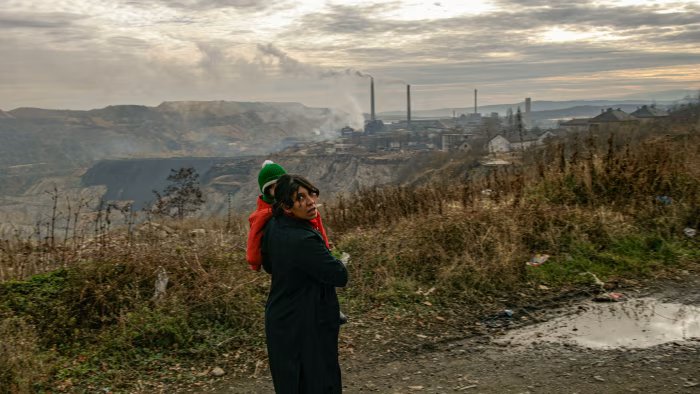
In his office on the fringes of downtown Bor, Časlav Gavrić, a serious, chain-smoking man in early middle age, considered how life has changed in the seven years since Zijin Mining came to the copper town in eastern Serbia, around 50 miles from the Romanian border.
The veteran miner and union activist struck a note of studied ambivalence as he recounted the weeks after the Chinese mining group’s takeover went through in 2018. At first, he said, negotiations between his union and Zijin had been tough. “It was about holidays and overtime . . . and not eroding the rights we have here as workers.” But, as for their new Chinese colleagues and neighbours, it was difficult to make any sweeping statements. The smattering of their people regularly seen in town belonged to the managerial class. For the workers, things were decidedly different. “They are practically invisible,” Gavrić said.
Friendships were rare between the Serbian mine workers in Bor and the foreigners they now sweated alongside. At the beginning, some tentative connections were made, though these were mostly discouraged by management, Gavrić said. “The Chinese [bosses] told them to stay separate. To not develop these contacts with the local population.”
If innumerable column inches have been devoted to China’s Belt and Road Initiative since its adoption by Beijing in 2013, its relationship with Serbia — a founding member and recipient of billions in Chinese investment over the past decade — has been less examined. Zijin Mining Group is valued at more than $100bn. The scale of its international portfolio is difficult to fully comprehend. It includes vast copper assets in the Democratic Republic of Congo and Tibet, along with gold mines in Papua New Guinea and Colombia, Australia and Tajikistan. In 2018, Zijin promised $1.26bn of investment to the Serbian government for a 63 per cent stake in the Bor mines (the rest is still owned by the state), as well paying off a lingering $200mn debt.
Since then, Bor has become a key pillar of Chinese influence in the Balkans. The logic is clear: China needs increasingly vast amounts of copper to fuel its manufacturing and renewable industries, and the Serbian government has been happy to help. The exact terms of the deal between Zijin and the Serbian government have not been fully disclosed. Nor has the precise amount of copper that makes its way from Bor to China each year. Zijin Mining did not respond to requests for comment on this story.
For many Serbs, Gavrić among them, the deal had looked promising enough. It seemed to offer the immediate prospect of renewal in Bor, no small thing for a city scarred by bouts of economic boom and decline. But it also provoked unease. What, many Serbs and foreign observers asked over the subsequent months and years, would it mean for the government to give over control of such important national resources to a foreign power?
Life in Bor has always rested on a simple truth: mining is everything. The first Roman settlers scratching for gold knew this. As did Đorđe Vajfert, the early 20th-century Serbian industrialist, who secured a hefty chunk of French investment capital to form the French Society of the Bor Mines, the Concession St George. But it was not gold but copper, accidentally discovered at the turn of the 20th century, that sparked the delirious excitement of Vajfert and his Parisian backers.
By the 1910s, it was clear that Bor was not merely a regional wonder. There was considerable pride in the knowledge that very few copper mines in the whole of Europe could compete in terms of scale or prestige. It didn’t take long to understand that this gift carried its own dangers. The expansion of the flotation and smelter systems was accompanied by a thickening of the air, as sulphuric fumes belched into the atmosphere. Agricultural workers began to notice the land declining into a previously unknown barrenness. But such concerns were no match for the relentless march of industry.

In 1951, the mines were brought under state control as production boomed. By the early 1960s, the Bor mining complex began to be administered under workers’ self-management. Long-promised technological advances were completed and women were encouraged to take up technical positions. Bor began to acquire a reputation for cosmopolitanism, with one census in the mid-1960s recording a total of 19 different nationalities in a city of fewer than 30,000 inhabitants, most of them miners or workers in associated professions.
Gavrić put it well enough. Life in Bor is marked by a central paradox: the better its economic health, the worse its physical wellbeing. There is little doubt about the rise in the levels of arsenic being carried into the air, as production has ramped up. Today, locals say, washing left to dry outside turns black within minutes. The number of people diagnosed with lung cancer has risen sharply since 2018. As the years have passed, nearby villages and towns have been threatened with demolition in the hunt for fresh resources.
At first, many of the more senior Serbian workers were encouraged by Zijin’s promises to keep pollution to a minimum. Disappointment had calcified over the preceding decades. Marija Jankovic’s parents were among the many ambitious young professionals who moved to Bor in the late 1960s from around Serbia. To push out for new beginnings in this corner of the country was nothing unusual then. The move made perfect sense for two young architects searching for a place to settle and build their shared future. Wages in Tito’s Yugoslavia were cresting to a historic high and good work could be found without too much discomfort. Housing — predominantly in the form of solidly built high-rise apartment blocks — was both affordable and readily available. These were years of plenty, of optimism and apparently unstoppable growth in the increasingly dense little city on the country’s eastern fringes.
Jankovic’s sister was born in the local hospital in 1974, with Marija arriving four years later. Despite their comfortable salaries and the closeness of life in the community, something nameless had always gnawed at Marija’s mother. It was tough to disregard the constant reek of industrial chemicals and cloying thickness in the air, as well as a ceaseless low-pitched whine that hummed day and night. As a toddler, Marija’s sister had developed a persistent rattling cough. When the infant Marija began to develop the same, their mother’s resolve hardened. Bor was no place to raise a young family, she decided. They were, Marija has joked in the decades since, some of the city’s first ecological refugees. They have not been the last.
By the time Jankovic returned to the city of her birth as an adult in the mid-2000s, it was difficult to reconcile reality with the place she had crafted in her imagination. On leaving Bor, her family had settled in Sombor, a quiet town in the north-west of the country. But Bor had always remained a rich topic of dinner-table conversation for the family. On graduating from art school in Belgrade, Jankovic knew precisely where she wanted to be. She packed a camera and set off for two months, with the intention of creating a photo series on Bor and its people.
The city came as a shock. She still remembers the first time the full scope of the open pit mine revealed itself, bathed in an unnaturally bright orange light — the sort she had never encountered before, or seen anywhere since. Few markers of the old prosperity remained. The once-thriving main street was reduced to a series of fast-food joints and rundown bars, populated by hard-nosed miners and committed daytime drinkers. A decent family-sized apartment could be bought for just €6,000.
Today, the city has again been transformed. This time, by Chinese investment. The desolate main street Jankovic documented in the early 2000s has been revitalised. It no longer has a single empty storefront.
When I arrived in Bor this spring, the sun was at its peak. I wasn’t sure if my eyes were playing tricks or whether the streets were coated in a barely perceptible yellow dust. My accommodation was a flat on the eighth floor of a well-kept 1960s tower block, administered by a severe middle-aged woman. From the balcony, Jankovic and I looked out across the city, to the hills at its perimeters. The mines lay out of sight, somewhere just beyond the horizon.
Despite its insalubrious climate and simmering social tensions, the city provokes fierce local pride. If Bor can be a tough place to build a life, those who do so guard their dignity. This self-image, of uncowable resilience and gallows humour, was something I came across repeatedly. There are several painted murals across Bor. One in particular caught my eye, daubed across the bottom of a residential block. “We are the children of the dust,” it proclaimed.
Serbia is going through a period of political turbulence. Over the past year, the country has been gripped by a series of national protests, which have occupied the heart of the capital city of Belgrade. The unrest was triggered last November, when 16 people were killed by a freshly renovated roof canopy that collapsed at the train station in Novi Sad, Serbia’s second-largest city. The first demonstrations were led by students at the University of Belgrade, who blamed the Novi Sad disaster on years of unchecked government corruption. They were soon joined by a cross-section of Serbian society, from disaffected teachers and civil servants to agricultural workers in the north and east.
In March, more than 300,000 demonstrators gathered in Belgrade for what was labelled Serbia’s largest protest in recent history, a significant milestone in a nation with a rich history of regime-toppling civil unrest. The sound of screeching whistles has become ubiquitous, along with slogans such as “Pumpaj!” (“pump it”) and “Corruption Kills”, often daubed against a vivid red handprint. Though overwhelmingly peaceful, a mass demonstration in June saw protesters clash with police, leading to dozens of arrests.
Chief among protesters’ demands has been the removal of the authoritarian government led by President Aleksandar Vučić, whose Serbian Progressive Party has been in power since 2012. The January resignation of his prime minister, Miloš Vučević, did nothing to soothe the unrest. But despite months of pressure, Vučić, an authoritarian who, in his mid-twenties, served under the brutal rule of Slobodan Milošević, has refused to waver. Last November’s catastrophe brought other, long-simmering questions into the open. Some are existential: who really owns Serbia anyway?

In the summer of 2024, a series of demonstrations took place in central Belgrade against a proposed lithium mining project in Jadar, western Serbia. The EU is desperate for a domestic source of lithium — a key component of the electric batteries used in mass-produced electric vehicles — and Vučić has been happy to oblige. For many Serbs, the Anglo-Australian mining corporation Rio Tinto, which was slated to develop and administer the project, has become a symbol of unwanted foreign corporate influence.
Amid the escalating tensions, concerns about pollution or the working conditions of Bor’s Chinese miners receded from national headlines. Under the terms of the 2018 bilateral trade deal between the two countries, Serbian labour laws were temporarily suspended for Chinese nationals working in the country. Several credible reports by human rights groups and charities spotlighted harsh conditions and alleged violations. According to several Chinese workers interviewed by Balkan Insight in 2021, passports were routinely confiscated, wages withheld and shifts were dangerously long.
A protest had been scheduled in Bor, and the main street teemed with a crowd of orderly demonstrators, young and old, who held banners and chanted. The procession halted in the main square to observe a lengthy silence for the victims of the Novi Sad disaster. A nearby billboard displayed a jolly, pixelated cartoon child along with the daily levels of carbon monoxide in the air. Not too bad, ran the ironically appreciative consensus from the crowd.
That night, I met Dragan Stojmenović at a bustling bar on the main street. A thoughtful, gently mannered man in early middle-age, he answered my questions with careful deliberation, straining against the din from the 1980s indie classics blaring from a pair of battered speakers.
If there was ever anything close to a golden age for Bor, it probably arrived in the postwar years, Stojmenović said. The 1950s and 1960s were a time marked by a historic lack of nepotism and corruption. As for today, the fundamental issue wasn’t the Belt and Road Initiative or Chinese influence, or whatever other spin you wanted to put on things. Capital — whether Chinese, American or western European — would flock to wherever it could extract the resources it demanded for its survival, he said. “It is not imperialism, colonialism or communism. It is almost feudalism [in] Serbia.”
Stojmenović had seen many changes during his decades in the city. He had raised his family in Bor. His daughter, a psychology student, had recently moved away for university. Like many young people, she had left for a chance at a better future. Stojmenović did not want to leave. Bor was his home and if setting down roots in such a place might be unfathomable to an outsider, then that was their imaginative failure. Stojmenović was a warm, insightful conversationalist. He offered a full and frank account of Bor and his own history within it.
Robert Mišić is another of Jankovic’s friends from her early-2000s stint in the city, a wiry middle-aged man with piercing eyes. We met at a restaurant in town. He remembered the pre-Zijin days well. They were not times to get overly romantic about, he said. “Fifteen or 20 years ago, there was an old smelting factory. It was very dangerous. I remember the smoke that would cover the whole area.”
For Mišić, it was reasonably simple. The Serbian state could not afford to properly invest in the mines and the Chinese were the most promising partners. The issue was, he felt, that not enough of the raw materials stayed in Serbia; that the bounties of the earth flowed out while only the harm remained. Mišić, who is an engineer by trade, as well as an internationally respected caver, told me of his passion for wildlife. Even in the old days, the region was home to an array of birds in the environmentally protected areas surrounding Bor. Swallows and magpies, even a small cluster of eagles. “This diversity has collapsed. There are drones that scare the birds. There is no water.” Spotlighting these issues is not risk free. Mišić has also been outspoken about alleged corruption of local political elites. This has not been without consequence. A couple of years ago, he was set upon by a group of local Serbian men who broke his leg. His main attacker was given a fine rather than the prison time Mišić expected.
After lunch, Mišić invited me and Jankovic to his home on the edges of town. In the living room, a faded military portrait of a young Mišić jostled for attention with photos of him and his caving friends in various exotic locations around the world. At the edge of his land was another view of the city and the mines that dominated it.
Night had drawn in by the time I met Dejan Nikolić, a Bor native and prominent ecological activist, who was recommended as a perceptive voice on the environmental issues plaguing the town. We agreed to meet at a bar on the main street. It soon became clear that Nikolić, a stocky, restless man with a booming voice, was not particularly interested in my questions. Instead he had a very important message to impart and would not deviate from it nor moderate his rapid-fire pace of transmission.
There were things I had to understand, Nikolić said. Serbia was not some lawless backwater. “We have laws, very good ecological laws. But the state does not always obey them.” The Serbian people deserved better: this lack of transparency over the deal with the Chinese was inexcusable. “The raw materials go to China. No one really knows how much copper, how much gold [is leaving] the country . . . The Chinese have a very aggressive mining system. In 20 or 30 years, we could lose all the mineral resources in our country.” Bor’s hospital was full, he claimed, of otherwise healthy young men who had suffered heart attacks; the oncology ward crammed to bursting with victims of its toxic air.
Bor seemed a fittingly uneven symbol of modern Serbia’s travails. A small, chronically polluted city reliant on foreign investment, left to the consequences of its exploitation, for as long as the profits rolled in. For all its contradictions, it was still a city for which people felt immense pride. As Jankovic put it, there were other places in Serbia that might not weather the coming storms, but Bor would not be among them. “It will always survive, in some form.”
The next morning, we woke early and prepared for the drive back to Belgrade. Our planned route would take us through one of Serbia’s lush national parks, before opening out along the clear waters of the Danube, a few hundred metres from the Romanian border. On leaving town, I turned back once to watch Bor disappear in the rear-view mirror, the thin yellow dust glinting in the pale spring light.
Find out about our latest stories first — follow FT Weekend Magazine on X and FT Weekend on Instagram