
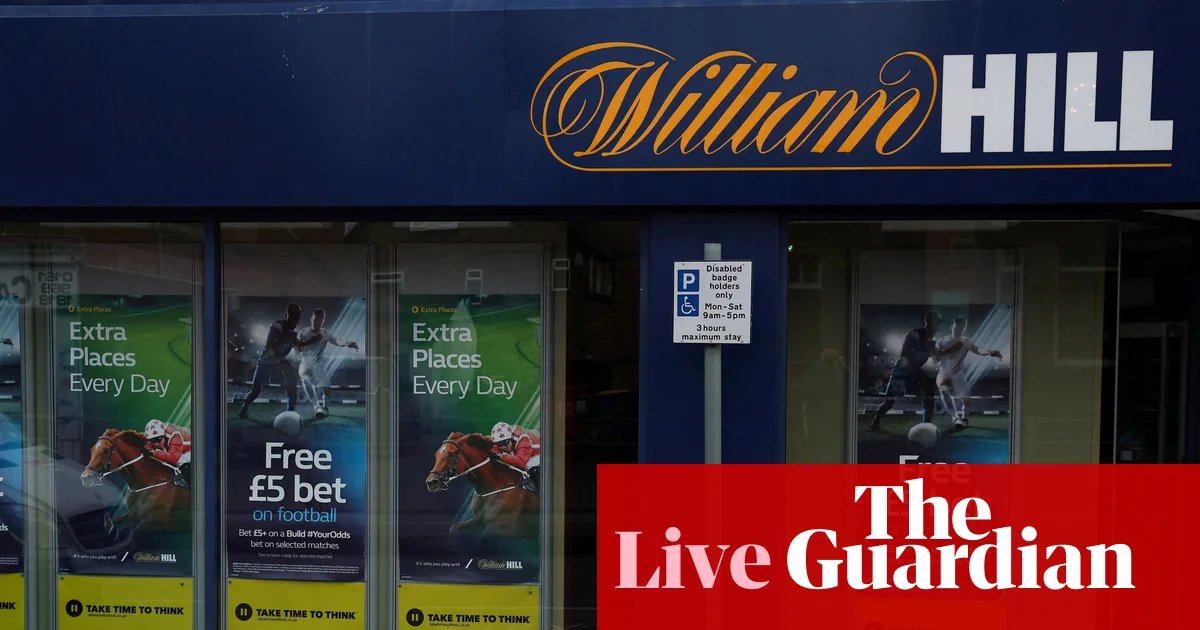
William Hill owner Evoke considers sale or break-up after UK tax hikes
Just in: UK gambling company Evoke is considering breaking itself up, following the tax rises announced in last month’s budget.
Evoke, the firm behind William Hill, 888, and Mr Green, has told the City it has decided to review its strategic options.
This will include “the consideration of a range of potential alternatives to maximise shareholder value, including, but not limited to a potential sale of the Group, or some of the Company’s assets and/or business units,” it explains.
Evoke says the move is “further to the Company’s announcement on 26 November 2026”, in which Evoke predicted that the rise in gambling duties announced by chancellor Rachel Reeves – including almost doubling the UK’s Remote Gaming Duty from 21% to 40% – would cost it £135m.
Before the budget, the company claimed it could close up to 200 betting shops if Reeves raises taxes on the gambling sector.
Key events
Closing post
Time to wrap up.
Shares in gambling company Evoke have jumped by 14% after it has said it is considering a sale or breakup of the group, after warning of a £135m hit from tax increases announced in last month’s budget.
Evoke, which owns William Hill and the 888 online casino brand, told the stock market it has appointed bankers at Morgan Stanley and Rothschild to explore potential options to secure its future.
The decision comes only four years after the business, then known as 888 Holdings, paid £2.2bn to buy William Hill’s network of 1,400 bookmakers, in an unexpected foray into bricks-and-mortar betting.
Elon Musk’s space exploration company SpaceX is preparing to list on the stock market next year in a move that could raise more than $25bn (£19bn) and value the business at more than $1tn, according to reports.
SpaceX, which designs, builds and launches rockets, is said to have started discussions with banks about an initial public offering (IPO). It could join the stock market in about June or July, according Reuters, which cited an unnamed source familiar with the matter.
A flotation could rival the market value that the oil company Saudi Aramco achieved during its listing in 2019, which remains the biggest in history. It raised $29bn at the time, at a valuation of $1.7tn.
Rachel Reeves has condemned leaks before her make-or-break budget as “unacceptable” as she revealed her income tax U-turn was agreed in partnership with Keir Starmer.
Defending her tax and spending plans before MPs on the Commons Treasury committee, the chancellor said she had been frustrated by “leaks that were clearly not authorised” before her November speech.
“I want to reiterate in the strongest terms that leaks are unacceptable,” she said. “The budget had too much speculation, there were too many leaks, and much of the leaks and speculation were inaccurate. [It was] very damaging, as well as the IT security issues.”
Tbe silver price has hit a record high, lifted by fears of supply shortages amid rising demand.
The chief executive of the Office of Rail and Road (ORR) is stepping down in April 2026.
Switzerland: Lower US tariffs effective from 14 November
The lowering of U.S. tariffs on Switzerland to 15% from 39% will be effective retroactively from 14 November, the Swiss government has announced.
That’s a relief to businesses that had been saddled with the highest U.S. duties in Europe.
In a statement, the Swiss Economy Ministry said that with the U.S. tariff ceiling now at 15%, trade-weighted U.S. tariffs on Switzerland will fall by around 10% on average, improving access to the U.S. market for Swiss firms.
It said:
“The competitiveness of Swiss companies will also be strengthened, as they will once again enjoy similar conditions on the U.S. market as companies from the EU or other U.S. trading partners with a similar economic structure.”
14 November was the day when Donald Trump agreed to cut US tariffs on Switzerland from 39% to 15% as part of a new trade pact.
There’s a very subdued start to trading in New York, ahead of the Federal Reserve’s monetary policy decision in a little over four hours.
The Dow Jones Industrial Average rose 13.7 points, or 0.03%, at the open to 47,573.96. The S&P 500 fell by 0.10%, and the Nasdaq Composite lost 0.17%.
Berenberg analyst Jack Cummings has said an outright sale of Evoke could work, but a buyer would inherit its substantial debt, Reuters reports.
Entain and Flutter are unlikely buyers due to competition concerns, as all three have significant UK online businesses, he added.
Evoke shares rally by 9%
Although Evoke’s shares are now up more than 9% today at 24p, they’re still down around 60% so far this year.
The Financial Times points out:
Shares in Evoke have more than halved since the chancellor’s plans to raise taxes on the UK gambling sector were first reported in August. The company’s market capitalisation has sunk to just £94.3mn, down from a peak of about £1.7bn in 2021.
Government bond prices are slipping today, as investors grow fretful that central banks may not cut interest rates as much as hoped.
Germany’s 10-year borrowing costs hit their highest level since March this morning, around 2.87%, as traders price out any chance of further European Central Bank rate cuts.
French 10-year yields rose 3.2 basis points to 3.59%, also around their highest since March.
ORR chief John Larkinson stepping down amid railways shake-up
The job of regulating Britain’s roads and railways is about to become vacant, at an exciting time for the rail industry.
John Larkinson has decided to step down as chief executive of the Office of Rail and Road (ORR) in April 2026, after seven years in the role, and two decades at the ORR.
The decision comes as the government brings landmark legislation to reform the railway before Parliament. This bill will create Great British Railways, bringing together 17 different organisations and running Britain’s railways as a single organisation for the first time in decades.
It also comes just days after the ORR abandoned a plan to run the express Manchester-London 7am Avanti service without passengers, after an outcry to run it as a ‘ghost train’ to improve network efficiency.
aLarkinson says:
“There is never a perfect time to move on, but most of my tenure as Chief Executive has been against a backdrop of rail reform, and I feel that the introduction of the Railways Bill into Parliament is an appropriate time to depart. I want to give a new Chief Executive the opportunity and the time to continue the process of transforming the ORR into its new roles set out in the Railways Bill and support the creation of Great British Railways.
Hopes of warming relations between Dutch and China over Nexperia row

Lisa O’Carroll
The Chinese owner of Dutch chip maker Nexperia has formally invited the Dutch management to travel to China for talks, fuelling hopes that the complete breakdown in relations between the two in the wake of the Dutch government’s intervention in the company, will be resolved.
Wingtech, which has not engaged with Nexperia in the Netherlands for months, described the invitation as a “proactive step” which aimed to restore “normal governance” and safeguard supply of chips.
The Dutch government move at the end of September triggered a worldwide ban on the exports of Nexperia chips from the Netherlands after the Communist Party in China backed Wingtech.
While the supply was restored as part of a deal struck between Donald Trump and Chinese president Xi Jinping at the end of October, relations between Nexperia and its Shanghai owner completely broke down.
Two weeks ago Nexperia in the Netherlands sent an open letter to Wingtech pleading with it to engage in communications, vital for the chip supply. The breakdown in relations further risked chip supply as Nexperia only makes wafers which are then sent to China for finishing before being exported back to key industries such as the car sector in Europe.
Wingtech said:
“This proactive step of sending a formal invitation for talks represents another important effort by Wingtech to advance the resolution of the dispute and reflects the company’s sense of corporate responsibility. It also demonstrates Wingtech’s willingness to engage in open communication with the Dutch government, the shareholding custodians, and other relevant parties, with the goal of restoring Nexperia’s normal governance structure, restoring a healthy development path, and safeguarding the stability and smooth functioning of the global semiconductor supply chain.”
Shares in Evoke have jumped 5% after it told the City it was considering strategic options.
William Hill owner Evoke considers sale or break-up after UK tax hikes
Just in: UK gambling company Evoke is considering breaking itself up, following the tax rises announced in last month’s budget.
Evoke, the firm behind William Hill, 888, and Mr Green, has told the City it has decided to review its strategic options.
This will include “the consideration of a range of potential alternatives to maximise shareholder value, including, but not limited to a potential sale of the Group, or some of the Company’s assets and/or business units,” it explains.
Evoke says the move is “further to the Company’s announcement on 26 November 2026”, in which Evoke predicted that the rise in gambling duties announced by chancellor Rachel Reeves – including almost doubling the UK’s Remote Gaming Duty from 21% to 40% – would cost it £135m.
Before the budget, the company claimed it could close up to 200 betting shops if Reeves raises taxes on the gambling sector.