
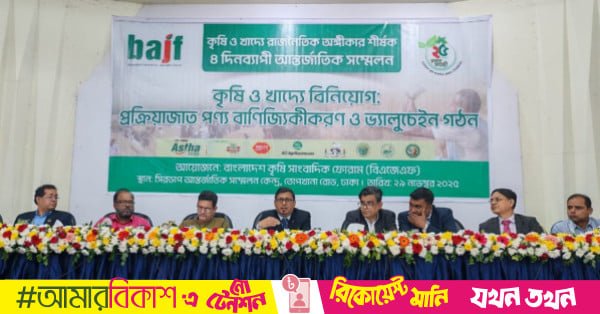
The current government has placed high priority on agriculture, with Chief Adviser Professor Yunus emphasising the need for Bangladesh to expand technology-driven production following models like the Netherlands, Chief Adviser’s Press Secretary Shafiqul Alam said today (29 November).
“The Netherlands, despite its size, exports $133 billion in farm goods each year, and Bangladesh can also double or even triple output on limited land, but higher production alone is not enough unless small farmers are protected,” he said while speaking as the chief guest at a conference at the Cirdap auditorium in the capital.
The four-day conference, titled “Investment in Agriculture and Food: Quality Agricultural Inputs, Processed Products, and Building Value Chains for Commercialisation,” focused on political commitment in agriculture and food and was organised by the Bangladesh Agricultural Journalists Forum (BAJF).

Shafiqul Alam said sudden surges in harvests often push prices down, leaving farmers without fair returns. “This is why small cold storage units, modern preservation systems, new markets, and export channels need to be developed at the village level,” he said.
Agriculture, politics, and global trade are closely linked; for instance, during the China–US soybean dispute, Bangladesh imported soybeans from the United States, drawing a powerful US farm lobby to Bangladesh’s favour – a new form of foreign policy engagement, he noted.
He added that China has expressed interest in large-scale investment in the jute sector, including joint ventures, technology transfer, and modern production facilities across the entire value chain. “If this interest materialises, we expect new jobs, higher export earnings, and stronger overall economic activity in Bangladesh’s jute industry,” he said.
He noted that traditional retting methods have discouraged farmers from continuing the practice, which has limited progress in jute diversification. “No one wants to do jute retting anymore because the old, labour-intensive process has reduced interest,” he said.
Chinese investors, he added, are interested in processing one million tonnes of jute in Bangladesh and producing biofertiliser, energy, and affordable plastic alternatives. With the right technology, jute could again capture a significant share of the global market.
“Agriculture determines much of Bangladesh’s direction, future, and national trajectory. It influences not only food security but also political stability, foreign relations, and overall economic capacity,” he said.
Referring to the 1974 famine, he described it as the most devastating year in Bangladesh’s 54-year history. Citing recent research by Dr Naomi Hossain, he said the study estimated that about 1.5 million people died.
“A lack of capacity in the then government, weak reserves, global agricultural politics, and failures in the market system made the famine far worse,” he said. Food hoarding and market instability, he added, deepened the crisis further.
Shafiqul Alam noted that the experience of 1974 has shaped policymaking in every government since and that food-import-dependent countries can quickly face pressure during global disruptions.
Bangladesh now relies on the international market to meet a food deficit of 6–8 million tonnes, but global tensions – such as the Ukraine war, instability in the Middle East, or sudden export bans – can make imports difficult, he said.
“For food security, strong reserves, adequate stock, and the capacity to import quickly are essential,” he said.
He added that the country currently has the capacity to store 2 million tonnes of grain. “This should be increased to 5 million tonnes so that markets remain stable during global shocks,” he said.
Rising salinity, shrinking cultivable land, and the impacts of climate change require investment in new varieties, new technologies, and sector-specific research, he noted.
He criticised the destruction of farmland through unplanned housing, saying village homes stand empty while agricultural land continues to shrink. Planned rural development is necessary to address this reality, he said.
Emphasising that Bangladesh’s future is inseparable from agriculture, the press secretary said, “Whoever forms the next government, and whoever becomes policymaker, the goal must be food self-sufficiency, surplus production, and protection of farmland and farmers.”
“We may not become the Netherlands, but with 10 years of focused effort, we can make significant progress,” he added.