

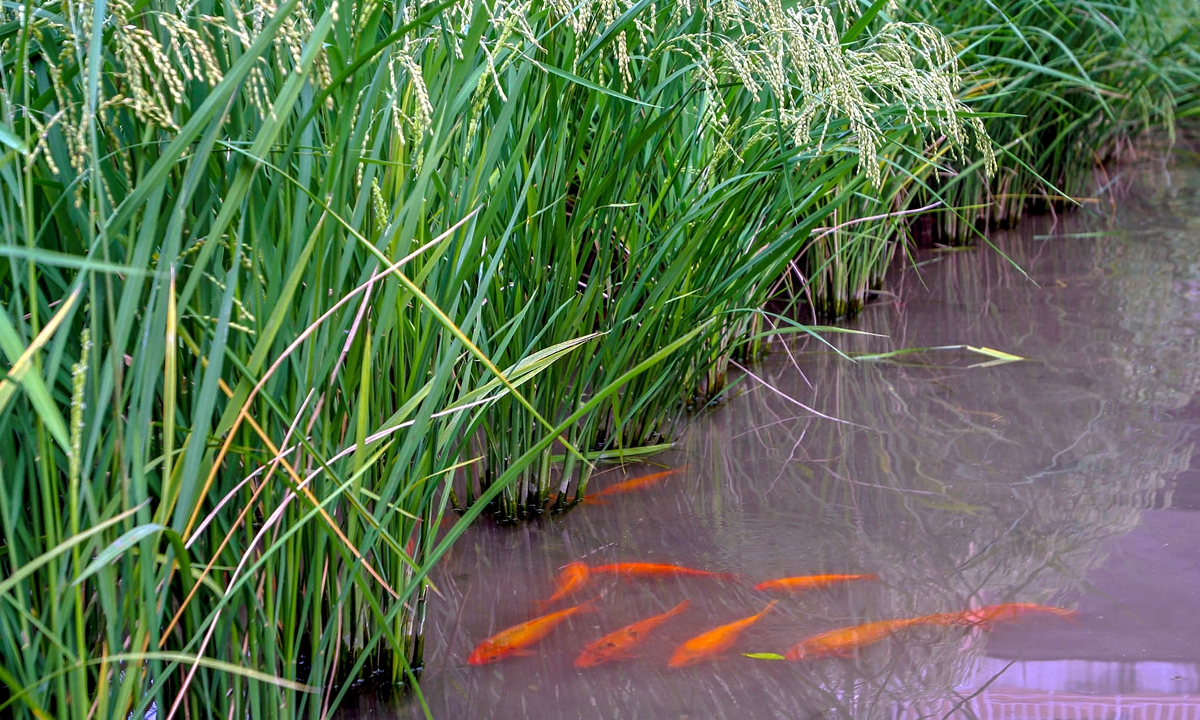
Qingtian Rice-Fish Culture System in Lishui, Zhejiang Province Photo: IC
Whenever she goes, flower cultivator Deng Jihui always carries a small yellow flower that breathes a refreshing cooling sweetness.
The flower is called “Suxin Lamei,” or “wintersweet.” In Deng’s hometown, Jingguan Town in Chongqing, this flower has been cultivated for more than 500 years, standing as a hallmark of the local “living agricultural legacy,” Deng told the Global Times.
It is no exaggeration to call this little flower a “living” legacy. Thanks to the rural workers’ efforts, its local cultivation area expanded to around 13 square kilometers and it keeps on growing. The floral industry now enables villagers to earn annual incomes ranging from 10,000 to 300,000 yuan, while also boosting the Jingguan town’s cultural tourism.
The Chongqing town’s wintersweet story represents one of many examples showcasing the modern growth of China’s nationwide agricultural heritage. Just recently, a report led by the Ministry of Agriculture and Rural Affairs was released, detailing the mechanisms through which such rural legacies are being preserved in China.
Where land leads
So far, a total of 188 agricultural heritage systems were classified as “important” in China. Such agricultural systems encompass diverse categories such as “mulberry-sericulture,” “Tea Culture Systems,” “dryland farming systems,” “rice farming systems,” and the cultivation of traditional Chinese medical herbs and flowers, according to the report.
Compared to agricultural heritage sites in other countries, one defining feature of China’s rural legacies is their historical depth. Tea cultivation has been practiced on the Mengding Mountain in Sichuan Province since the Han Dynasty (206BC – AD220). The rice cultivation system of Wannian county in Jiangxi Province dates back to pre-historic times, representing one of the world’s earliest known rice cultivation sites.
China’s agricultural legacy traces its origins to pre-historic times, it later diversified during the Qin (221BC-206BC) and Han dynasties (206BC – AD220), and still thrives today. This unbroken chain of farming practices is rooted in China’s agricultural civilization. Throughout its history, China’s agriculture has been characterized by the concept of adapting practices to local conditions, Li Shuangze, a rural heritage expert told the Global Times.
In Aohan Banner, north China’s Inner Mongolia Autonomous Region, the tradition of dryland farming remains intact. Unlike rain-rich regions of southern China like the Zhejiang Province, the local’s semi-arid and low-rainfall climate has led its people to develop agriculture reliant solely on natural rainfall for over 8,000 years.
Here, grain crops such as foxtail millet are cultivated across its sloping ridges. While agricultural mechanization has been gradually introduced into farmers’ lives, the locals still maintain their old traditions of controlling the dibbler manually for even seed distribution. Generations of farmers have created this practice, skillfully aligning crop choices and seasonal rhythms. This deeply rooted agricultural practice has, in turn, shaped the very fabric of local customs and folk beliefs.
“We still perform the rain-prayer ritual every year. And whenever our children leave home for work in distant cities, we always make sure they take some [millet] with them,” Huhe, a local villager, told the Global Times.
A living ecosystem
By creating a bond between nature’s gifts and human belief, China’s agricultural heritage is never solely about cultivation. It is about nurturing a living ecosystem that fosters a complex web of lives.
In 2005, the “Qingtian Rice-Fish Culture System” in Lishui, Zhejiang Province, was designated as one of the first pilot sites for the Globally Important Agricultural Heritage Systems (GIAHS) by the Food and Agriculture Organization of the United Nations.
Following the logic of “using fish to fertilize the fields and using rice to nurture the fish,” the Qingtian ecosystem is where plants and animals thrive together, with a history spanning over 1,300 years.
In ancient times, people developed this system for survival. The rice plants provide shelter and pollen as feed for the field fish, while the fish till the soil, remove weeds, and consume pests, thus protecting the rice plants.
But now, this ancient agricultural wisdom has evolved thanks to modern technology and innovative farming methods. The local community has integrated monitoring systems and established a digital supervision platform for the rice-fish ecosystem. Meanwhile, a museum and a dedicated heritage park have been opened in the area, benefiting local tourism. Per year, the local area can attract an average of 470,000 visitors, driving approximately 15 million yuan of touristic income.
A recently released report mentioned many other villages that have chosen to integrate local agriculture with cultural tourism.
Deng’s wintersweet cooperative is one example of this shift. The floral cooperative she operates initially focused on selling wintersweet nationwide through offline channels. Now, the local community has not only launched online sales but also created a range of cultural products, such as “wintersweet flower tea” and “wintersweet-leaf paintings.”
“Planting is just the first step; our goal is to revitalize this heritage through modern approaches, ultimately enabling it to give back to rural development,” Deng told the Global Times.
Known to many as the “wintersweet fairy,” 39-year-old Deng has long been dedicated to the floral cultivation sector. Yet, as she told the Global Times, her rural experience always makes her “feel young at heart.” “I noticed a growing number of people bringing fresh ideas to expand our rural heritage. This creative energy, I believe, is what will keep our new generation of farmers forever young.”

Deng Jihui sales wintersweet plants through online streaming Photo: Courtesy of Deng Jihui