
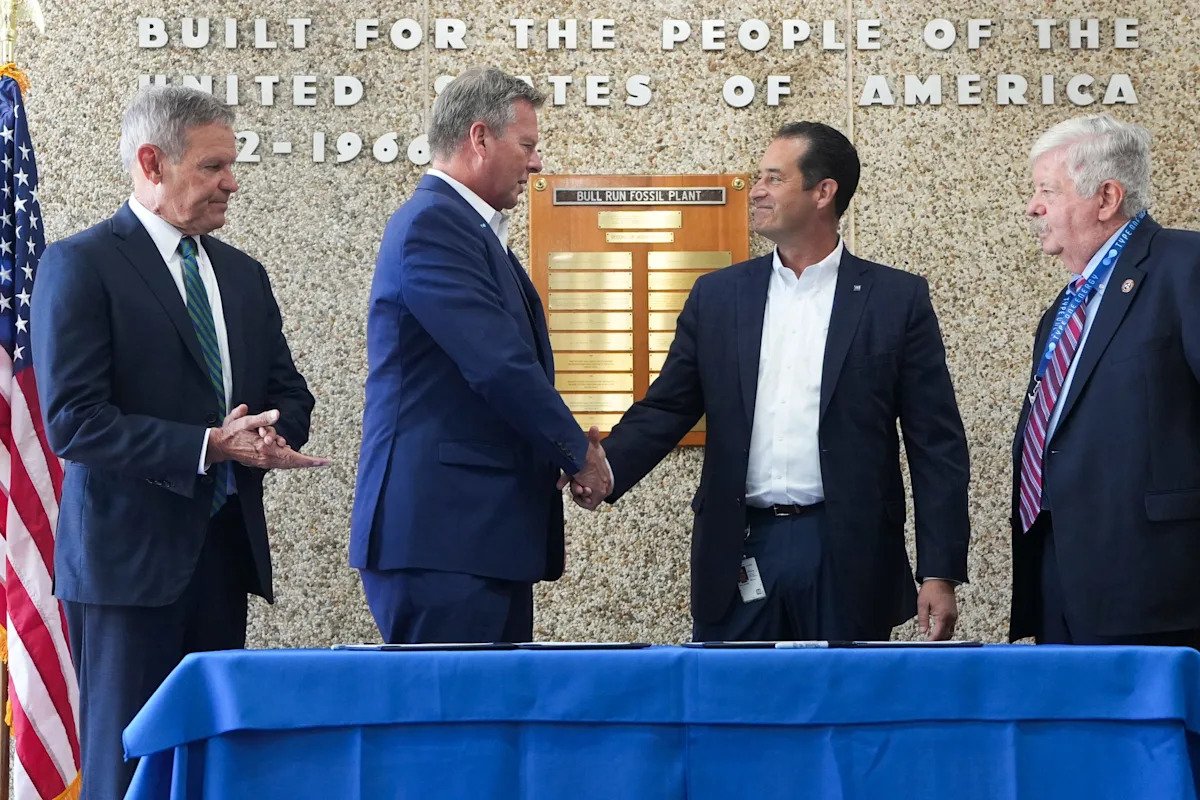
A Knoxville-based energy company and the United States’ largest public power provider marked a new start Sept. 19 for a project that could see commercial nuclear fusion become a reality.
The Tennessee Valley Authority issued a letter of intent that draws a roadmap for how the utility will work with Type One Energy Group, which aims to deploy the world’s first fusion power plant. The letter formalizes TVA’s interest in Type One’s planned fusion technology at a time of increasing demand for energy.
Executives from Type One and TVA made the announcement alongside state and local officials at the former Bull Run Fossil Plant site in Clinton, which TVA retired in 2023.
“This is an effort that has been going on for more than half a century, where scientists and engineers across the country − around the world − are working to forge the power of the stars,” Type One CEO Chris Mowry said during the announcement.
With the letter, TVA and Type One are opening a new chapter − the final one, Mowry said − in the history of commercializing fusion energy.
Get the KnoxBiz newsletter: Keep up with the latest news about the growing nuclear industry in East Tennessee
What work does Type One Energy hope to do at Bull Run?
Type One is looking for the Holy Grail. That’s fusion, Mowry said.
“It’s clean. It’s safe. It’s abundant. It can power society for the coming millions of years,” he said. “And it’s been a long time coming.”
Type One is planning to build the world’s first commercial nuclear fusion plant, using the former TVA site to house a prototype. The company aims to use a machine called a stellarator to contain plasma much hotter than the sun at the pilot plant. It would be developed in the former fossil fuel plant’s turbine room.
Type One leaders have previously said they hoped to start constructing Infinity One, the prototype stellarator, in 2026. A TVA news release says that stellarators are unique in demonstrating “stable, steady-state operation with high efficiency.” That makes them an attractive choice for TVA, according to the release.
The prototype is designed to verify aspects of the design and serve as a training platform.
Its design plan is a break from traditional nuclear power plants, which use fission – the process of splitting uranium isotopes apart – to create heat. Fusion reactions instead smash hydrogen isotopes together to make energy.
Fusion also has a different safety profile from fission projects. Unlike processes that rely on fission, nuclear fusion can’t produce a nuclear meltdown, and it won’t create intensely radioactive waste that remains dangerous for hundreds of thousands of years. It’s regulated by the state, Mowry told members of the media, and it’s held to standards closer to those applied to hospitals working with nuclear medicine than those for fission development.
Type One isn’t alone with its interest in fusion or its plans to be first to build a fusion plant. Commonwealth Fusion Systems, an MIT Plasma Science and Fusion Center spinout, got zoning permission for its own plant in Virginia on Sept. 19.
If Type One’s Infinity One stellarator moves forward successfully, it’ll pave the path for Infinity Two, the world’s first commercial nuclear fusion plant. The plant could be operational by the mid-2030s, and the power it generates could add to the Tennessee Valley’s baseload. The plant is envisioned as producing 350 megawatts of continuous electricity, a little over a fifth of one of the reactors at TVA’s Sequoyah Nuclear Plant near Chattanooga.
Company scientists have built stellarators, but not under the Type One name. Once the plant is fully online, it could create as many as 330 jobs, according to Type One’s leaders. They committed to that job creation and a $223.5 million investment to Tennessee when they received a $4.5 million grant from the state’s Nuclear Energy Fund, established under Gov. Bill Lee.
According to Type One’s latest public quarterly report, it has $1.4 billion in total assets.
Lee said during the announcement that energy companies like Type One can support the communities that support them.
“The people of this community have created something that the rest of the world looks at and says they wish they had,” he said.
Lee also has said he aims to make Tennessee the nation’s leader in nuclear energy. In 2023, he formed a nuclear energy advisory council that issued its final report in October 2024.
Type One was the first recipient of the state nuclear funding, meant to bolster Tennessee’s nuclear future. Nine others − a mix of companies and governments − have followed as Tennessee undergoes what some in the nuclear space are calling a nuclear renaissance.
Type One’s lead scientist told Knox News in March that company won’t need a scientific revelation to move the stellarator design forward. As Mowry put it, “This is not a science project.”
“This is an actual commercial fusion power plant that we are embarking on here,” he said.
But the collaboration between the utility and Type One will be educational, according to TVA CEO Don Moul.
“We have a lot of learning to do,” Moul told Knox News. “I think that’s the value of being able to have the stellarator here, having our power services shop provide some of the fabrication capabilitie and, quite frankly, having some of our staff here help with the operational input with some of the designers so that we make this practical, but also as forward moving as possible.”
Financing, licensing and design will need to be done before construction can get underway, Mowry said.
“Because this is not a science project, we’re really focused on an engineering effort, using the existing materials and existing fundamental technologies,” he said.
Mariah Franklin is a growth and development reporter focused on technology and energy. Email mariah.franklin@knoxnews.com.
Support strong local journalism by subscribing at knoxnews.com/subscribe.
This article originally appeared on Knoxville News Sentinel: TVA, Type One Energy plan world’s first nuclear fusion power plant