

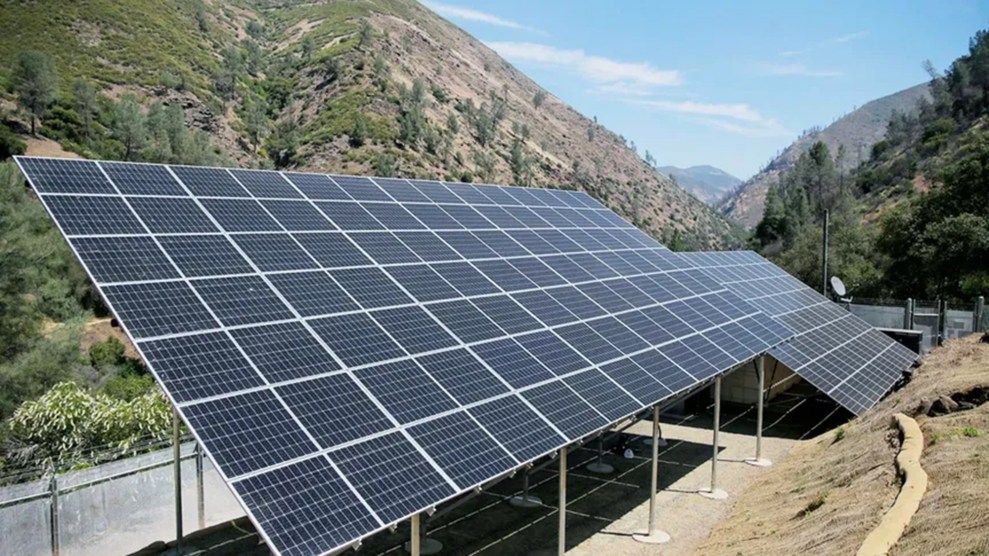
A solar array built by BoxPower is charging batteries and keeping five PG&E customers supplied with electricity at a remote grid project in Briceburg, California.BoxPower
This story was originally published by Canary Media and is reproduced here as part of the Climate Desk collaboration.
Michael Gillogly, manager of the Pepperwood Preserve, understands the wildfire risk that power lines pose firsthand. The 3,200-acre nature reserve in Sonoma County, California, burned in 2017 when a privately owned electrical system sparked a fire. It burned again in 2019 during a conflagration started by power lines operated by utility Pacific Gas & Electric.
So when PG&E approached Gillogly about installing a solar- and battery-powered microgrid to replace the single power line serving a guest house on the property, he was relieved. “We do a lot of wildfire research here,” he noted. Getting rid of “the line up to the Bechtel House is part of PG&E’s work on eliminating the risk of fire.”
PG&E covered the costs of building the microgrid, and so far, the solar and batteries have kept the light and heat on at the guest house, even when a dozen or so researchers spent several cloudy days there, Gillogly said.
Over the past few years, PG&E has increasingly opted for these “remote grids” as the costs of maintaining long power lines in wildfire-prone terrain skyrocket and the price of solar panels, batteries, and backup generators continues to decline. The utility has installed about a dozen systems in the Sierra Nevada high country, with the Pepperwood Preserve microgrid the first to be powered 100 percent by solar and batteries. The utility plans to complete more than 30 remote grids by the end of next year.
Until recently, utilities have rarely promoted solar-and-battery alternatives to power lines, particularly if they don’t own the solar and batteries in question. After all, utilities earn guaranteed profits on the money they spend on their grids.
But PG&E’s remote-grid initiative, launched with regulator approval in 2023, allows it to earn a rate of return on these projects that’s similar to what it would earn on the grid upgrades required to provide those customers with reliable power. The catch is that the costs of installing and operating the solar panels and batteries and maintaining and fueling the generators must be lower than what the utility would have spent on power lines.
“It all depends on what the alternative is,” said Abigail Tinker, senior manager of grid innovation delivery at PG&E. For the communities the utility has targeted, power lines can be quite expensive, largely due to the cost of ensuring that they won’t cause wildfires.
PG&E was forced into bankruptcy in 2019 after its power lines sparked California’s deadliest-ever wildfire, and the company is under state mandate to prevent more such disasters. PG&E and California’s other major utilities are spending tens of billions of dollars on burying key power lines, clearing trees and underbrush, and protecting overhead lines with hardened coverings, hair-trigger shutoff switches, and other equipment.
But these wildfire-prevention investments are driving up utility expenditures and customer rates. Solar and batteries are an increasingly cost-effective alternative, Tinker said, with the benefits outweighing the price tag of having to harden as little as a mile of power lines.
PG&E saves money either by getting rid of grid connections altogether or by delaying the construction of new lines. Microgrids can also improve reliability for customers when utilities must intentionally de-energize the lines that serve them during windstorms and other times of high wildfire risk—an increasingly common contingency in fire-prone areas.
Angelo Campus, CEO of BoxPower, which built most of PG&E’s remote microgrids, sees the strategy penciling out for more and more utilities for these same reasons. “We’re working with about a dozen utilities across the country on similar but distinct flavors of this,” he said. “Wildfire mitigation is a huge issue across the West,” and climate change is increasing the frequency and severity of the threat.
Utilities are responsible for about 10 percent of wildfires. But they’re bearing outsized financial risks from those they do cause. Portland, Oregon-based PacifiCorp is facing billions of dollars in costs and $30 billion in claims for wildfires sparked by its grid in 2020, and potentially more for another fire in 2022. Hawaiian Electric paid a $2 billion settlement to cover damages from the deadly 2023 Maui fires caused by its grid.
Microgrids can’t replace the majority of a utility’s system, of course. But they are being considered for increasingly large communities, Campus said.
Nevada utility NV Energy has proposed a solar and battery microgrid to replace a diesel generator system now providing backup power to customers in the mountain town of Mt. Charleston. Combining solar and batteries with “ruggedized” overhead lines should save about $21 million compared to burying power lines underground, while limiting impacts of wildfire-prevention power outages, according to the utility.
Some larger projects have already been built. San Diego Gas & Electric has been running a microgrid for the rural California town of Borrego Springs since 2013, offering about 3,000 residents backup solar, battery, and generator power to bolster the single line that connects them to the larger grid, which is susceptible to being shut off due to wildfire risk. Duke Energy built a microgrid in Hot Springs, North Carolina, a town of about 535 residents served by a single 10-mile power line prone to outages, on the grounds that it was cheaper than building a second line to improve reliability.
In each of these cases, utilities must weigh the costs of the alternatives, Tinker said. “It’s complicated and nuanced in terms of dollars per mile, because you have to be able to do the evaluation of individual circuits, and what can be done to mitigate the risk for each circuit,” she said.
Whether microgrids are connected to the larger grid or not, utilities need to maintain communications links with them to ensure the systems are operating reliably and safely. PG&E is working with New Sun Road, a company that provides remote monitoring and control technology, to keep its far-flung grids in working order.
It’s important to distinguish remote microgrids built and operated by utilities from other types of microgrids. Solar, batteries, backup generators, and on-site power controls are also being used by electric-truck charging depots and industrial facilities that don’t want to wait for utilities to expand their grids to serve them. Microgrids are also providing college campuses, military bases, municipal buildings, and churches and community centers with backup power when the grid goes down and with self-supplied power to offset utility bills when the grid is up and running.
Utilities have been far less friendly to customer-owned microgrids in general, however, seeing them as a threat to their core business model. Since 2018, California law has required the state Public Utilities Commission to develop rules to allow customers to build their own microgrids. But progress has been painfully slow, and only a handful of grant-funded projects have been completed.
Microgrid developers and advocates complain that the commission has put too many restrictions on how customers who own microgrids can earn money for the energy they generate when the grid remains up and running. Utilities contend that they need to maintain control over the portions of their grid that connect to microgrids to avoid creating more hazards.
“It is a very difficult balance that PG&E is constantly trying to strike, with the oversight of [utility regulators] and other stakeholders, between safety and reliability and affordability,” Tinker said. “That’s something we’re trying to thread the needle on.”
But as the costs of expanding and maintaining utility grids continue to climb, and solar and batteries become more affordable, utilities and their customers are likely to see more opportunities to make microgrids work, Campus said.
“The cost of building poles and wires and maintaining distribution infrastructure has grown substantially over the past 20 years,” he said. “Look at the cost of distributed generation and battery—it’s an inverse cost curve.”