
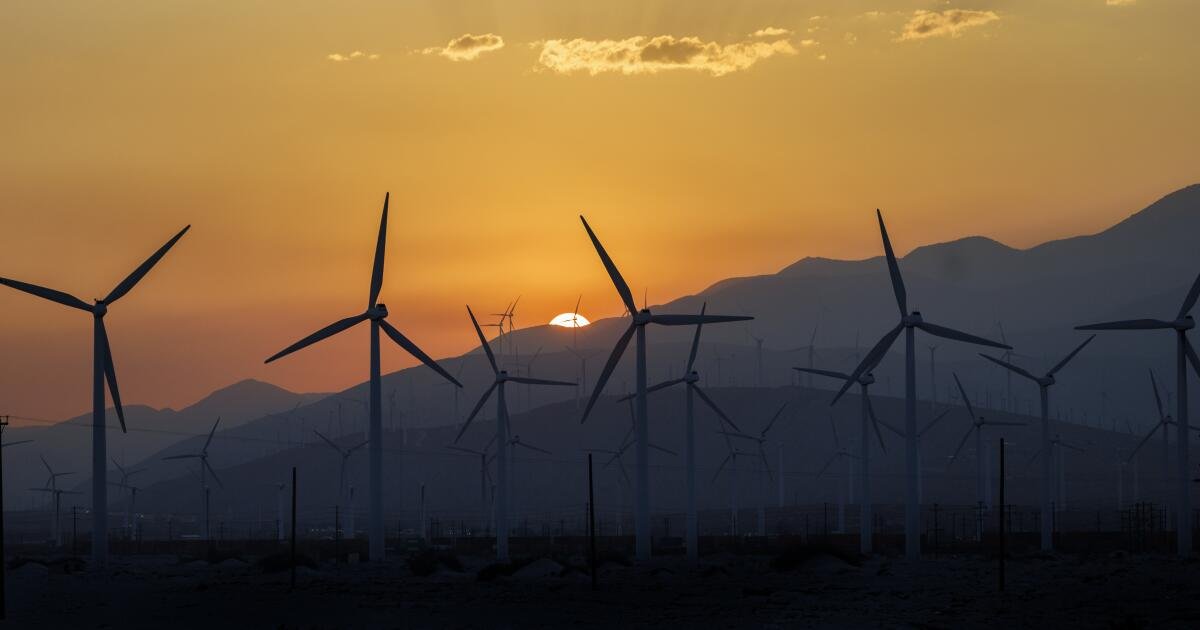
The Trump administration has been slashing green energy incentives, freezing the construction of wind farms and ordering coal-burning power plants to keep running longer than planned. And yet, more American homes and businesses are getting their power from renewable sources than ever before — and in greater amounts.
In June, almost one-quarter of U.S. power generation was green, up from 18% in the year-earlier period, according to data compiled from the U.S. Energy Information Administration. The question now is whether the trend continues with President Donald Trump back in the White House.
The recent growth in renewables usage is almost certainly tied to investments made prior to Trump’s election in November. Under former President Joe Biden, the U.S. backed roughly $100 billion of investments in clean energy. Now, the Trump administration is taking a sledgehammer to those efforts by opposing offshore wind farms and eliminating incentives for electric vehicles and solar power.
Still, Texas is a prime example of how the energy markets have changed. In early March, the state’s grid set a record for wind generation; in mid-June, it registered a new peak for electricity produced from renewable resources; and a month later, Texas notched new highs for battery storage and solar generation.
Similar records are popping up across the country on an almost weekly basis, as utilities harvest a windfall from new solar and wind farms that can be built faster and more affordably than fossil fuel-based power plants.
For utilities and folks operating the nation’s power grids, the wave of green energy couldn’t come at a better time because volatile weather, electric vehicles and a rash of AI-focused data centers are all driving up demand.
In April, as grid operators were girding for heat waves, nearly one-third of U.S. power was generated from renewable sources. And the green energy boom is spreading beyond the sun and wind belts. The New York grid hit a renewable record on June 24. New England recorded new highs for both wind and solar power this summer and the grid in the Mid-Atlantic states reported a record renewable harvest in late June.
“We’re in an entirely new landscape for load growth, so this is none too soon,” said Forest Bradley-Wright, state and utility policy director at the American Council for an Energy-Efficient Economy. “Every solution available will need to be called on.”
If all of the utility-owned solar panels in California were considered one facility, it would have ranked at the end of July as the second-largest power plant in the world. At noon on July 30, solar generation on the state’s CAISO grid hit 21.7 megawatts, second only to the capacity of the Three Gorges Dam on China’s Yangtze River.
For much of that day, the sun accounted for roughly two-thirds of the power Californians were using and the panels fed into batteries that, once the sun went down, juiced nearly one-third of the state.
The Texas power market is truly the Wild West of electricity.
As a deregulated, wholesale market, the state’s consumers can choose their provider and plants are only paid for what they produce. In this eat-what-you-kill energy world, utilities have turned en masse to a novel tool: big batteries.
These so-called storage facilities let power players sock away electrons when demand (read: prices) are low and discharge the juice when usage peaks. Often, the most economical strategy is storing solar power during the day and releasing it in the evening when the lights and TVs switch on and air conditioners are still humming.
A rash of new storage facilities have been switched on in Texas this year, shoring up the grid with record amounts of reserve power.
In Wyoming, the largest coal-producing state in the U.S., it’s common for tractor trailers to get blown over onto their sides. Such is the power of the wind on the Great Plains. And it’s steady as well as strong.
On the Southwest Power Pool grid, which stretches from the Dakotas south to Texas, new records for wind power were reached twice in August alone. At one point on Aug. 16, almost two of every three electrons in the system were coming from turbines.
Good, cheap or fast? Typically, one only gets to choose two of those things. But now, solar, wind and other renewable sources are clicking all three of those boxes when it comes to producing electricity. So-called green energy is currently the lowest-cost and quickest-to-deploy power generator in the U.S., even without incentives, according to research from Lazard.
Given President Donald Trump’s attacks on green power, the decisions made by utilities have become more fraught than usual and a bit more complicated than just choosing the cheapest plant to build. In May, Gordon van Welie, chief executive officer of the ISO New England grid, told the Federal Energy Regulatory Commission that his organization was counting on large quantities of offshore wind to meet rising demand. Three months later, the Trump administration ordered crews to stop working on a project off the coast of Rhode Island where 45 of 65 planned turbines have already been installed, a directive that it now has to defend in court.
The facility was expected to power roughly 350,000 homes. Administration officials say solar and wind is unreliable and too connected to China-based supply chains. Trump’s term, however, will likely be over long before any new coal-fired or nuclear plant can be built to replace that capacity.
“We need more electrons in this country and the industry seems to have an agnostic view,” said Lazard Managing Director Samuel Scroggins, referring to where electrons originate. “Practically speaking, renewable energy is ready to build and it remains below the cost of alternatives.”
Stock writes for Bloomberg.