
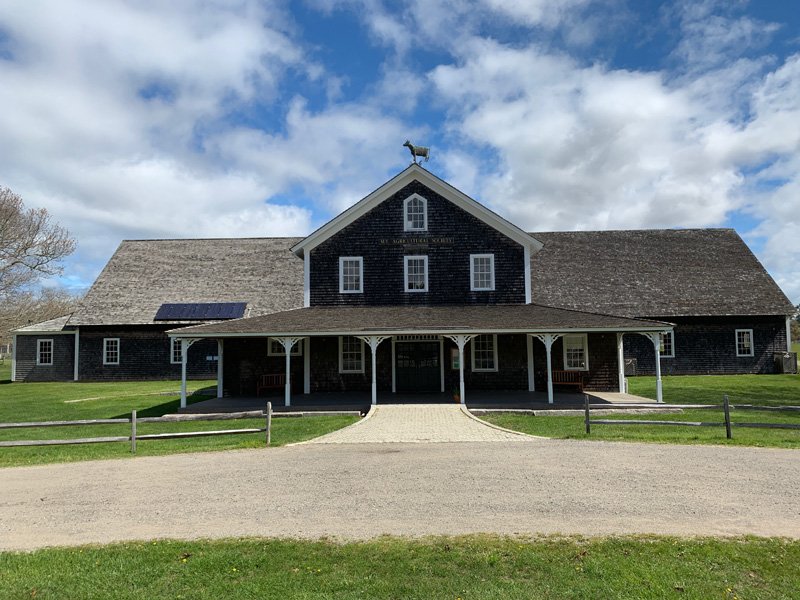

Every August, a flood of over 60,000 people inundate West Tisbury for the fair’s thrilling carnival rides, fried and sugary delectables, and endearing farm animals. Amid the bustle and commotion, however, some might forget about the group behind the festivities.The Martha’s Vineyard Agricultural Society (MVAS) is a nonprofit that aims to support local farmers, while also preserving the Island’s agricultural history. Founded in 1859 and located at what is now West Tisbury’s Grange Hall, the Ag Society started as a group of farmers who wanted to improve the limited resources available to them on the Island.
MVAS President Lauren Lynch said that the founders wanted to facilitate the spread of information among Island farmers to mitigate the impacts of their geographic isolation from the mainland. “[The Ag Society founders] saw that the farmers were removed from everything that was happening on the mainland and how much the farmers here were missing. They decided to form the Ag Society to get everybody together to help keep everybody up to date on the latest technologies, science findings, and trends, so that everyone can share information.”
Nowadays, the Ag Society primarily focuses on bringing outside services and educational resources to Martha’s Vineyard and providing grants to farmers and domestic growers in partnership with the Slough Farm Foundation.
“We know farming is an extremely challenging field, no pun intended, and especially on an island. Our goal is to help give farmers access to grants and education and any support that they need,” said Lynch.
Lily Walter owns Slipaway Farm on Chappiquiddick. This year, she received $4,000 from the grant program. She used the funds to plant a perennial windbreak, a dense shrub barrier that shields more fragile crops from wind damage.
“It was great to have their financial backing, because we wouldn’t have been able to do it on our own,” said Walter. “We’re really lucky to have them on the Island.”
With the need for more parking space due to increased summer tourism, MVAS moved to its current location on Panhandle Road in 1994. Although the trustees initially considered constructing the new Ag Hall out of metal, many objected. A petition for making a wooden structure similar to the old building received 700 signatures, enforcing the Island community’s commitment to preserving the Society’s history.
That November, a team of 42 volunteers known as the “Barn Busters” traveled to Woodsville, N.H. Once there, the Barn Busters worked together to dismantle an old wooden barn board by board, and truck the lumber back to the Island. For a day, hundreds of local volunteers united to raise, shingle, sheath, and paint the new Ag Hall. That night, the volunteers celebrated the completion of the new Ag Hall with a Barnraisers Ball, now an autumn tradition.
In 2018, the board of trustees decided to hire full-time staff in order to both keep up with rising fair attendance and operate on a more professional scale. Prior to the board’s decision, MVAS was entirely volunteer-run.
Program and Outreach Manager Lucy Grinnan said that the addition of full-time staff positions, such as theirs, has allowed MVAS to increase its capabilities as a nonprofit. “A lot of the work that we have been doing recently has really been building capacity,” they said, “We’ve been able to really increase from doing 30 programs a year to doing more like 100.”
Similar to farming, the organization’s programming tends to vary with the seasons. In the summertime, there are social events for seasonal farm workers who might be unfamiliar to the Island, such as flower arranging workshops and farm tours, along with edible garden tours led by community members.
Autumn involves cranberry bog tours and Ag Society traditions, such as the Harvest Festival and Brazil Fest, a festival celebrating rural Brazilian culture. Unfortunately, due to heightened fear among the Brazilian community following Immigration Customs and Enforcement (ICE) raids on Martha’s Vineyard and Nantucket days before, this year’s Brazil Fest was postponed from June to October.
During the winter, when many farmers focus on maintenance and preparation for the spring, MVAS tailors its workshops to topics such as pest management, grant writing, and business planning. Once spring kicks off, the workshops revolve around growing seasonal crops such as carrots, tomatoes, and herbs.
Grinnan said that although many MVAS events cater to commercial and domestic farmers, they can also involve the greater Island community. “Most of our things are solidly in supporting people in agriculture, whether that’s backyard or commercial. But sometimes it goes a little further into community sustainable living.”
One example is the Ag Society’s 4-H programming. 4-H is a national nonprofit youth development organization emphasizing hands-on learning; the Martha’s Vineyard chapter was revitalized in 2018 after a decades-long hiatus by former MVAS board president and vice president Brian Athearn and Julie Scott, respectively. Currently, there are 11 4-H clubs on the Island that meet monthly. These groups are led by community volunteers and organizations and focus on various topics, including painting agricultural scenes with Allen and Lynne Whiting, aquaculture with Martha’s Vineyard Shellfish, historical crafts with the Martha’s Vineyard Museum, and horses with Misty Meadows Equine Learning Center.
Athearn said that 4-H groups cover a wide range of interests, making it a positive outlet for kids during the Island’s off-season. “4-H touches everyone. It’s a great avenue, especially in a community where there’s nothing to do for kids.”
Grinnan said that the 4-H programming, which has a registration of roughly 80 children from different Island towns, promotes both social and hands-on interaction with the community. “The focus is really to introduce kids to each other and to the Island in a way that might be new for them, and to slowly build skills and responsibility.”
Another initiative that MVAS spearheaded in 2019 is the Community Deer Cooler, an old tractor-trailer converted into a walk-in refrigerator for hunters to store their deer. The cooler can store up to 40 carcasses. Although cooler users are charged a seasonal fee, the payment can be waived by giving meat through the Venison Donation Program. The program is a collaboration between MVAS, the Martha’s Vineyard Tick Program, Island Grown Initiative (IGI), and MassWildlife’s Hunters Share the Harvest Program.
The state initiative facilitates venison donations from hunters to participating processors throughout the state, who then distribute the meat to partnering food programs assisting people facing food insecurity. On Martha’s Vineyard, the venison is processed by IGI and distributed through its Island Food Pantry.
MV Tick Program Director Patrick Roden-Reynolds manages the cooler, which received a record number of 90 deer during the 2023 hunting season. He emphasized promoting deer hunting as an effective way to reduce the Island’s tick population, which uses deer as principal hosts to reproduce.
“If you deprive the ticks of the deer and deprive them of their meal, then it cuts their life cycle off, where they can’t produce larva for the next generation,” said Roden-Reynolds.
Along with the tick population, the cooler also aims to reduce the Island’s deer population. A balanced deer population for a region in Massachusetts is 12 to 18 deer per square mile, according to Mass Wildlife. On Martha’s Vineyard, the population exceeds 50 deer per square mile.
Roden-Reynolds, who said that the high deer population causes many farmers and growers to put up deer fences around their crops and flowers, highlighted the resulting challenge of preserving the Island’s biodiversity.
“With the number of deer we have across the Island, it’s really hard to conserve some of those rare and endangered species,” he said.
Another service that MVAS offers is its mobile poultry-processing unit, which processed a total of 2,000 chickens last year. Grinnan said that the unit makes it possible for local farmers to successfully capitalize on their chickens. “Before the mobile poultry-processing unit was established, there wasn’t really a way for farmers on the Island to raise poultry profitably, because they would have to bring them off-Island for slaughter.”
As for some of the Ag Society’s future goals, these include preserving the fair, expanding its year-round programming, continuing its organizational growth, and updating its buildings.
One of these buildings is the Paul Jackson House on Anthiers Way. Formerly owned by the celebrated Island farmer Paul Jackson left the Edgartown property to MVAS for agricultural purposes after his death in 2022. Currently, the property is being leased to various Island farms so they can house their summer workers, and MVAS hopes that the property can eventually house year-round personnel and be suitable for farming.
Grinnan underscored that a lack of housing makes it challenging for Island farms to retain workers. “It definitely makes it a lot harder for people to hire. We’ve seen a lot of farms move the direction of building employee housing as a way to ensure that they continue to have a stable workforce,” they said.
Lynch wants MVAS to increase its civic engagement on the Island. One issue of focus is the limit of community dinners that up-Island farms can host, with many farmers saying that the Chilmark select board’s regulations are too restrictive.
“I want to get to a position where the Ag Society can be a better advocate on the Island for farmer issues, whether it’s going to town meetings or looking at by-laws that are coming up that could affect farmers,” she said.
Grinnan emphasized how the presence of agriculture on the Island adds to its natural beauty. “A lot of the appeal for tourists visiting the Island is often that there are a lot of farms and that it’s really green,” they said. “That is something that needs to be protected and that won’t just maintain itself.”