

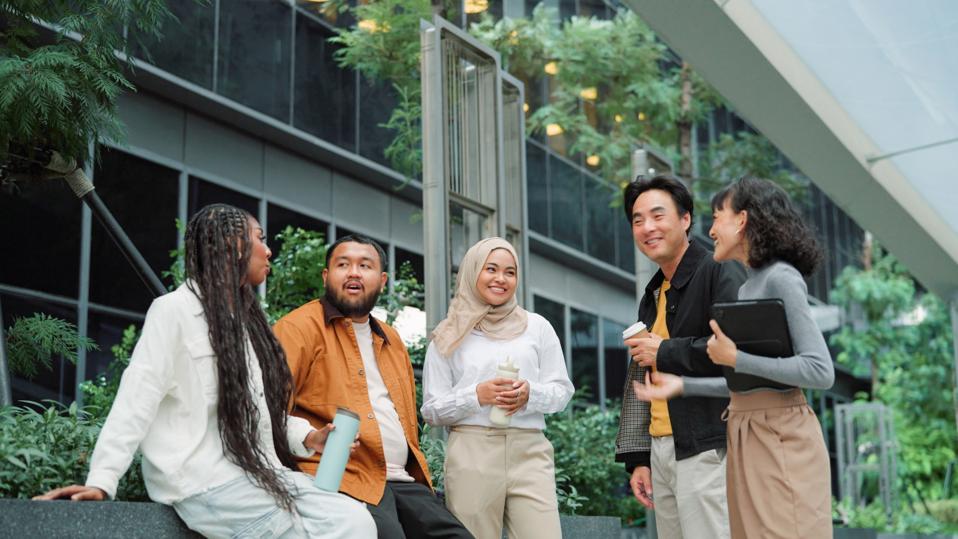
Inclusion at work means something different to each person. Every lived experience will bring a unique perspective.
getty
Inclusion at work remains a conundrum. For many workplaces, it has become an elusive goal, abandoned under the cloud of politics. Some won’t admit it, but they found it too hard to achieve. The difficulty is that inclusion does not have a single definition. For each person, it can mean something different, and it can change over time. That variability is part of the challenge. To add to that challenge, some groups were left out, or worse, they were excluded. Whilst some disengaged entirely, others worked against inclusion efforts in the workplace. Both have left the goal of inclusion further out of reach.
For businesses that want to retain staff and maximize their team’s potential, inclusion is essential. Inclusive leadership teams improve performance because they “encourage, empower, and engage” teams to solve problems together. McKinsey has long made the “business case for diversity.” They have published reports showing that gender-diverse teams financially outperform homogenous ones. Yet, fintech still struggles to hire and keep the talent most likely to bring diversity of thought and experience. Even the CIPD (Chartered Institute of Personnel and Development) has called for a “reaffirmation” of inclusion. They are urging organizations to “reset” it as a business strategy aligned to tangible outcomes.
I spoke with fintech leaders who shared real-world examples of how inclusion is lived as a daily practice.
Inclusion Means Perspectives Are Heard
Allison Theunissen, People and Culture Manager at Aveni, focuses on creating environments where people can thrive. She has learned that “inclusion means something different to everybody because everybody experiences it differently.” For some, it’s about feeling safe enough to speak up, even if you might get it wrong. It’s about addressing something head-on, asking questions, and, as she puts it, “that will make people feel listened to and cared about.”
For Allison, inclusivity is about the power of different perspectives. Then, ensuring they are heard, considered, debated, and brought into solutions. When ideas are ignored or dismissed, collaboration and trust break down. She believes inclusion requires ownership at every level, not just from HR or leadership. That ownership often starts with simple openness. She recalls a time she faced a situation she’d never encountered before and said to the employee, “I want to be inclusive. I might say something wrong, but please tell me.” This mindset extends to processes, policies, and communication. By inviting feedback, she created space for improvement. She made it clear she welcomed honesty: “Call me out if a process isn’t written in the right way or addressed in the right way. I want to learn.”
Inclusion Means Everyone Shares The Responsibility
Jenny Hadlow, COO and DEIB sponsor at Checkout.com, focuses on belonging. She defines this as how an employee feels every day when they come into the office. Describing culture as a “tangible experience,” she shapes it around merit and potential. To “focus on what you have done and what you’re capable of doing,” bias must be set aside. Jenny warns that businesses still operate in systems, countries, and with people who hold unconscious bias. That’s why her team makes “efforts to create that awareness and to fight that.”
Having grown up in a world where “girls were capable of anything,” she is determined to make that a reality for women in her business. Checkout.com celebrated a near gender-balanced hiring achievement in 2024. She credited the talent team and wider business for making it happen, calling it “collective ownership.” “It took so many people to create that outcome, which shows that we were coordinated and dedicated in our efforts.” For Jenny, inclusion is never a one-off project. It’s an ongoing, collective commitment.
Inclusion Means Differences Are Acknowledged
Rebekah Fox, Chief People Officer of Upvest, says inclusion begins with acknowledgement. She agrees that everyone’s experience is different, “and that’s OK.” She sees this as essential for engagement and performance. She said, “It’s imperative for people to feel included to be their most creative, most productive selves.”
Her company’s mission is “making investing as easy as spending money,” which means tackling wealth inequality head-on. To stay true to that purpose, psychological safety is central for them. This means asking better questions and using every interaction as a learning opportunity. She spoke of creating groups where people are “asking more questions than they are pretending to know the answers.”
Her team has launched grassroots task forces to assess inclusion. They have developed strategic pillars and created tailored inclusion toolkits for each team. They focus on retention, turning policies into lived practice, and training that goes beyond unconscious bias. This allows them to explore “how we can embrace our differences.” For Rebekah, it’s about seeing what’s missing and seeking to learn from it: “Acknowledge that you don’t have all the answers.”
Inclusion Means Difference Is A Strength
Gemma Ros, CTO at TheZebra.com, frames difference as strength: “My different perspective is not a liability. It’s a strength.” For her, inclusion means creating environments where no one has to hide parts of themselves to progress. She said that “coming from an immigrant background” has shaped her leadership style with grit. She can see patterns others might miss. She uses this as a superpower to “create environments where people don’t feel they have to code-switch to be taken seriously.”
Gemma can see barriers that others might not notice and works to reduce and ultimately remove them for her team. She celebrates the experiences of others and encourages them to share those experiences openly in the workplace. She aims for an environment where people are “excited to be their best versions of themselves.”
She also urges people to find mentors, sponsors, and peers who will advocate for them and help them progress. She describes those crucial voices as people who will “counter the voice that says you don’t belong.”
Inclusion Means Access Is Universal
Amanda Mocellin, COO of Traderoot International, says, “Inclusion means access with dignity.” For her, that includes infrastructure and economics. It means ensuring financial services are a tool everyone can use, no matter where they are.
She is passionate about removing barriers to access for all. These are in jargon, compliance, capital, or scale. She wants the smallest communities to have access to financial services to build safety and opportunity. Inclusion, in her view, is not about offering the same product everywhere, but about creating solutions that are locally relevant and truly responsive to different needs. To achieve that, Amanda believes leaders must ask how to build trust with different users and partners. She asks, “how locally relevant are you to their community?” This starts with “looking at who’s sitting around the table” and then asking, “who’s not here, and why are they not here?” Awareness, she says, is the first step to embedding inclusion properly.
Inclusion is not something you say; it’s something you do. And what you do will look different depending on who’s in the room, what barriers they face, and what strengths they bring. The most inclusive businesses are in tune with their mission and why they invest in the productivity and safety of their people. They see that no one experiences inclusion the same way. They are listening deeply and acting consistently. They are making sure everyone has the space, and the dignity, to belong, contribute, and thrive.