
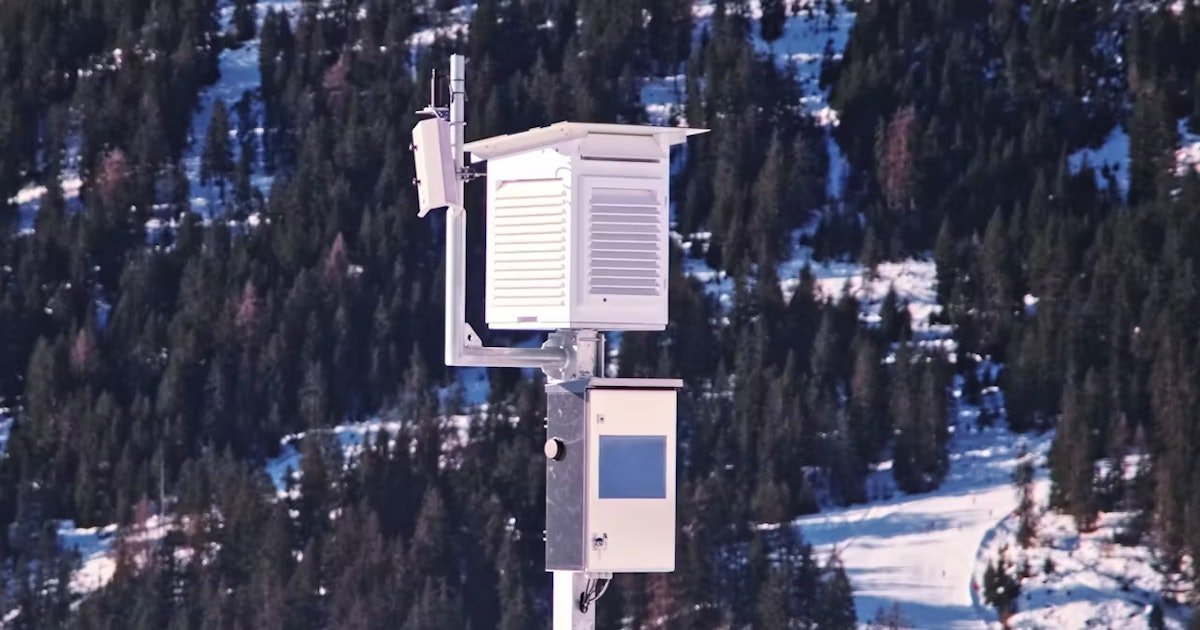
A small, white box with horizontal slats is a familiar sight at weather stations around the UK and around the world.
This louvered housing for thermometers measuring air temperature was invented in the 1860s by Thomas Stevenson, a lighthouse engineer and father of the author Robert Louis Stevenson. What is now widely known as a Stevenson screen was originally described by its creator as simply a “…box for holding thermometers”.
In fact, the Stevenson screen was a masterful innovation. Its simple and easily replicable design allowed the outside air to flow around thermometers while protecting them from direct sunlight and rain, which would otherwise affect the reading. The Stevenson screen made life easier for meteorologists, too, since there was no need to periodically remove a shade or do much beyond reading the thermometers themselves. It became widely adopted and, in its various modern forms, is probably the most recognizable device for monitoring the weather.
During a recent heat wave in Britain, the thermometers these boxes contain would have dutifully recorded very high temperatures. But, after 160 years of service, is it time for the Stevenson screen to retire?
In a new study, my meteorologist colleague Stephen Burt and I compared temperatures measured following the traditional approach with those obtained using a modern system.
Some small but revealing discrepancies emerged, particularly in calm winds overnight and on clear winter days. Despite this, the Stevenson screen remained remarkably effective at providing accurate and continuous measurements for more than 150 years.
The Aitken effect
One limitation of the Stevenson screen was highlighted by the Scottish meteorologist John Aitken as early as 1884. The screen, he argued, would not work well on calm and sunny days because it lacked natural ventilation.
No solution to this problem has been widely implemented, but the latest generation of thermometer screens include electric fans to force the air through. These are known as aspirated thermometers. In the US and Canada, networks of aspirated thermometers are emerging that look very different to Stevenson screens — some are cylindrical, some mounted on masts.
Aspirated thermometers are rare in the UK, but more are likely to appear in the future. Before making the switch, though, meteorologists have to be sure that they do more or less the same job. Major changes to the methods of measuring air temperature have to be made carefully and slowly to keep a consistent record of the climate.
Running a modern aspirated thermometer alongside a Stevenson screen is one way to identify differences in their measurements. We did this for three years at the Reading University Atmospheric Observatory, using an automatic system that generated over 1.5 million temperature records.
We were especially interested in comparing how the two methods captured daily maximum and minimum temperatures. Looking at these extremes at any one site provides a way of identifying local climate change.
Overall, there were remarkably few discrepancies, and those that did appear were small: in only 1% of cases, there were differences greater than 1°C. We estimated that across Europe about 4% of maximum temperatures will be affected in this way, and about 12% of recorded minimum temperatures. This is relatively minor, and will not affect the important conclusion that globally, air temperatures are increasing.
We found these differences did not just happen on sunny days, however, as they were evident at night, too. Calm or light winds at night allow the Stevenson screen to cool, making the minimum temperature it records lower than that of the aspirated thermometer. Conversely, daily maximum temperatures are mostly recorded when the wind is high, yet some maximum temperatures in the Stevenson screen still exceed those from the aspirated thermometer. These were mostly when the sun was low on the horizon during the winter, occasionally producing an anomalously warm daily maximum temperature.
Aitken’s insight has been largely neglected, but he was ahead of his time. The aspirated thermometer, as increasingly recommended by the World Meteorological Organization, overcomes the limitations of the Stevenson screen in light or no wind.
But for a device that is more than a century-and-a-half old, the Stevenson screen is still remarkably effective.
This article was originally published on The Conversation by Giles Harrison at University of Reading. Read the original article here.